Ministerial foreword
Department for Democratic Resilience
Democracy depends on argument, dissent, criticism, and the free exchange of experience. It also depends on citizens being able to distinguish reliable information from manipulation, coordinated deception, and rapidly amplified falsehood. In recent years, the public sphere has been transformed by digital platforms that allow events to be interpreted, shared, politicised, and escalated before trusted institutions have had time to establish facts or provide context.
This Green Paper addresses a central challenge for democratic government in the digital age: how can open societies reduce the harms caused by misinformation while preserving the liberty, pluralism, and disagreement on which democracy depends? The challenge is intensified by artificial intelligence. Generative systems now allow individuals, campaigns, hostile actors, commercial platforms, and informal networks to produce persuasive text, images, audio, video, and analysis at unprecedented speed. The effect is not simply more information. It is a new capacity to reframe lived experience without institutional mediation.
The Government’s objective is not to prevent citizens from criticising authority. Democratic trust cannot be rebuilt by suppressing dissent. The objective is to strengthen the conditions under which citizens can evaluate claims, understand the provenance of content, recognise synthetic or manipulated material, and receive timely public-interest context when events are being rapidly misrepresented.
Executive summary
This Green Paper argues that the misinformation problem is also a mediation problem. In the previous media environment, public events were usually interpreted through a relatively small set of institutions: broadcasters, newspapers, courts, official statistics, schools, universities, parties, unions, professional associations, and public agencies. These institutions were imperfect, partial, and sometimes wrong. Nevertheless, they slowed the formation of public meaning and made it possible for democratic disagreement to occur within a broadly shared evidential setting.
Digital platforms have weakened that order. A local incident, public-service failure, migration story, foreign-policy event, crime report, school dispute, medical controversy, or policing decision can now circulate horizontally before any trusted institution has established a stable account. Citizens no longer receive public meaning mainly through vertical channels. They encounter competing interpretations from peers, influencers, anonymous accounts, campaign groups, foreign operators, automated systems, and increasingly AI-generated materials.
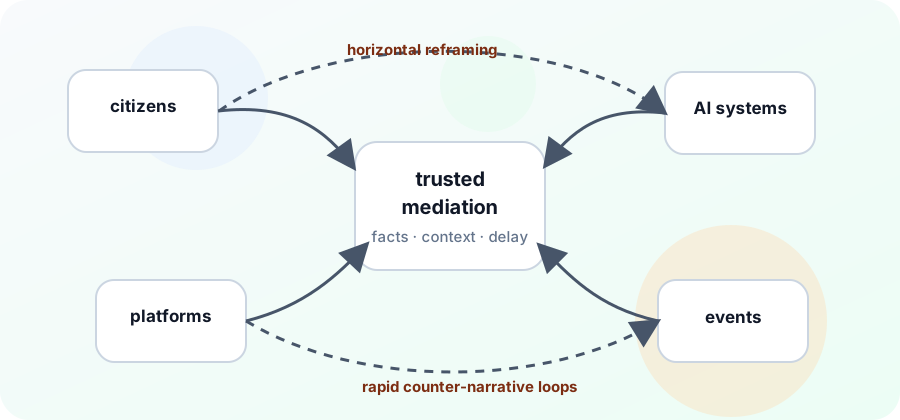
This document proposes a resilience framework based on provenance, platform accountability, institutional responsiveness, public-interest context, civic capability, and AI transparency. It does not assume that the state can or should become the sole arbiter of truth. It does argue that democratic societies require trusted mechanisms for slowing, checking, contextualising, and contesting claims before misinformation hardens into political reality.
Consultation question
How can democratic societies reduce misinformation in the digital age?
The question is deliberately broad. A narrow answer would focus only on false statements. This paper takes a wider view. Misinformation harms democracy not only when it inserts false facts into public debate, but when it disrupts the relationship between experience, interpretation, evidence, and institutional action. A citizen may be misled by a fabricated video, but may also be pulled into a distorted political reality by selective framing, decontextualised evidence, emotional repetition, or a cascade of confident explanations produced before facts are known.
1. The mediation problem
Political experience does not become political meaning automatically. A rise in rent, a hospital delay, a change in the local high street, a protest, a violent incident, a school controversy, or an official error must be interpreted. In a mediated public sphere, that interpretation is shaped by institutions with some degree of responsibility, memory, and reputational cost. The mediation layer may be flawed, but it provides delay, verification, comparison, and accountability.
The present difficulty is that this layer has weakened. Citizens can now move from experience to explanation almost instantly. A private grievance can become a public narrative. A local incident can become a national symbol. A partial clip can become proof of institutional corruption. An error can become evidence of conspiracy. A rumour can become a mobilising story before correction is possible. In such a system, the first successful frame often becomes more important than the most accurate account.
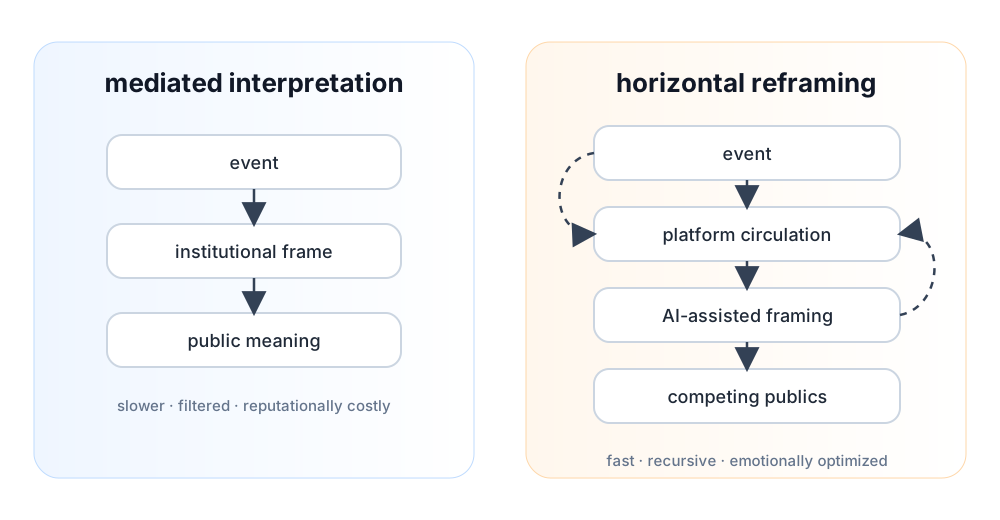
The Government recognises that mediation is not the same as control. Democratic mediation must allow disagreement, investigation, satire, political opposition, and minority experience. The goal is not to restore a closed information order. The goal is to develop democratic mediation that is fast enough to matter, open enough to be trusted, and resilient enough to resist manipulation.
3. Artificial intelligence
Artificial intelligence changes the problem because it allows reframing to be generated as well as distributed. A citizen, activist, campaign, or hostile actor can use AI to convert an experience into a speech, petition, news-style report, legal complaint, academic-sounding analysis, satirical image, emotional testimony, or targeted message. This capacity was once concentrated among parties, newspapers, think tanks, public-relations firms, and professional campaigners. It is now available more widely and at lower cost.
This has legitimate uses. AI can help citizens understand documents, challenge bureaucracy, organise campaigns, translate information, and participate in public life. It can also produce persuasive but unreliable materials that feel authoritative because they imitate institutional styles. A fabricated explanation can sound like journalism. A weak argument can sound like a policy paper. A conspiracy claim can be given the tone of legal analysis. A personal grievance can be inflated into a civilisational diagnosis.
The central policy problem is therefore not simply the detection of synthetic content. It is the social effect of synthetic plausibility. AI systems can give premature interpretation the appearance of competence. They can make fringe narratives look researched, make emotional claims look procedural, and make speculation look like evidence. In a fast-moving public sphere, this can reduce the ability of trusted institutions to provide stabilising context before public meaning has hardened.
4. Misinformation and misframing
Public debate often treats misinformation as a problem of factual falsity. That is too narrow. A democratic society must also address misframing: the presentation of technically real fragments in ways that produce a substantially misleading public meaning. A real video clip can mislead if cut at the wrong point. A true statistic can mislead if stripped of comparison. A genuine failure can mislead if presented as proof of a general conspiracy. A correct quotation can mislead if detached from the circumstances in which it was made.
Misframing is harder to govern than misinformation because it sits close to legitimate political interpretation. A democracy must permit citizens and parties to argue about what events mean. The state cannot outlaw every unfair inference. But democratic institutions can improve the conditions under which citizens evaluate frames. They can require clearer provenance, support rapid factual context, reduce covert amplification, identify synthetic media, and impose responsibility on platforms that profit from engagement while avoiding editorial obligations.
For the purpose of this Green Paper, misinformation is false or misleading content likely to cause public harm when circulated at scale. Misframing is the selective, decontextualised, synthetic, or emotionally manipulative presentation of content in a way that substantially distorts public understanding while avoiding straightforward factual falsity.
5. Proposed response
The Government proposes a democratic resilience framework built around six principles. The first is provenance. Citizens should be able to know whether content is human-made, synthetic, edited, official, anonymous, paid for, automated, or foreign-linked where such information is technically available and relevant to public risk. The second is platform responsibility. Platforms that structure public attention should have duties proportionate to their power to amplify, recommend, monetise, and personalise political content.
The third is institutional speed. Public bodies must become better at providing timely context during fast-moving events. Delay creates a vacuum in which misinformation and misframing thrive. This does not mean issuing premature certainty. It means clearly stating what is known, what is not known, what is being checked, and when further information will be provided. The fourth is public-interest routing. During major incidents, platforms should provide friction, context, and visibility for authoritative updates without suppressing lawful criticism or independent reporting.
The fifth is civic capability. Citizens need practical tools for evaluating provenance, synthetic media, emotional manipulation, statistical claims, and decontextualised evidence. Media literacy should not be treated as a school-only intervention. It should be a permanent civic capability supported across education, workplaces, public services, and community organisations. The sixth is contestable trust. Trusted institutions must be open to correction. Public trust cannot mean passive acceptance of official statements. It must mean visible procedures for evidence, challenge, revision, and accountability.
| Policy area | Proposed direction | Democratic risk addressed |
|---|---|---|
| Content provenance | Clearer signals for synthetic, edited, automated, paid, or official content. | Citizens cannot evaluate claims if they cannot identify their source or mode of production. |
| Platform duties | Risk-based obligations for amplification systems, political advertising, recommender design, and crisis response. | Attention systems can turn misleading frames into apparent public reality. |
| Rapid public context | Incident-response protocols for timely official updates, uncertainty statements, and correction pathways. | Slow institutions leave interpretive vacuums that are filled by speculation. |
| AI transparency | Labelling, auditability, and safeguards for synthetic political content and automated persuasion. | Machine-generated plausibility can disguise low-quality or malicious interpretation. |
| Civic capability | Public education on verification, framing, manipulation, and source evaluation. | Citizens need tools to resist both falsehood and manipulative truth-fragments. |
6. Safeguards
Any policy response to misinformation must protect legitimate disagreement. There is a danger that the language of resilience becomes a way of insulating institutions from criticism. The Government rejects that approach. Public trust cannot be manufactured by narrowing permissible opinion. It must be earned through competence, openness, correction, and proportionate regulation.
The following safeguards should therefore govern any future legislation or regulatory scheme. First, lawful political disagreement must not be treated as misinformation merely because it challenges official policy. Second, independent journalism, satire, academic research, whistleblowing, and public-interest campaigning require strong protection. Third, official rapid-response systems must distinguish between known facts, provisional assessments, and contested interpretation. Fourth, citizens must have access to appeal and correction mechanisms where content is labelled, downranked, or contextualised by public or platform systems.
These safeguards are not optional. Without them, democratic resilience policy could become self-defeating. Citizens who believe that misinformation policy is a cover for official narrative control will not become more trusting. They will move further into alternative interpretive networks. The legitimacy of the response therefore depends on visible limits to state power.
7. Consultation areas
The Government invites views on the appropriate balance between open democratic interpretation and the need to reduce harmful misinformation. It is particularly interested in the practical design of provenance standards, platform duties, public-interest routing during major incidents, AI-content labelling, audit rights for researchers, and independent oversight.
8. Conclusion
The digital age has changed the relationship between experience and political meaning. Social media allows experience to be circulated horizontally before institutions can mediate it. Artificial intelligence allows that experience to be reframed in persuasive forms at speed and scale. This creates opportunities for democratic participation, but also new vulnerabilities to misinformation, misframing, manipulation, and public fragmentation.
The task is not to restore an earlier information order. That order was never neutral, and it cannot be rebuilt unchanged. The task is to construct democratic mediation for a faster, more synthetic, more participatory public sphere. Citizens must remain free to dissent, criticise, organise, and reinterpret their own experience. But democracy also requires reliable ways to know what has happened, where claims come from, how content was produced, and which institutions can be held responsible when public meaning is manipulated.
This Green Paper therefore proposes a shift from narrow misinformation policy to democratic resilience policy. The aim is to protect the open society not by closing interpretation, but by making interpretation more accountable, more transparent, and more resistant to covert manipulation. Trust will not be restored by command. It must be rebuilt as a public infrastructure.
2. Social media and horizontal traffic
Social media has created an environment in which political interpretation moves horizontally between citizens at scale. This has democratic benefits. It allows neglected harms to become visible, enables rapid mutual aid, exposes institutional failure, and gives citizens tools to challenge official accounts. It also has democratic costs. Horizontal traffic can amplify outrage, reward simplification, remove context, intensify group suspicion, and allow highly motivated minorities to dominate the apparent meaning of an event.
When a public event occurs, the crucial contest is often no longer over the event itself but over the frame that attaches to it in the first hours. A platform environment optimised for speed and emotional engagement favours the frame that travels, not necessarily the frame that is accurate. By the time formal institutions respond, the event may already have been absorbed into a larger story about betrayal, decline, corruption, threat, hypocrisy, or persecution.
This paper uses the term horizontal traffic to describe the rapid circulation of interpretation between citizens, groups, influencers, and automated or semi-automated accounts without passing through established mediating institutions. Horizontal traffic is not inherently illegitimate. It becomes a democratic concern when speed, scale, anonymity, synthetic content, or coordinated amplification prevent citizens from knowing whether they are encountering genuine public opinion, manipulated attention, or machine-assisted political construction.