Explainer
The case for a collisionless society
A conversation that starts with bodies bumping into things ends somewhere more interesting: with a theory of intelligence, institutions and value as ways of preventing destructive overlap.
Start with a line. In one dimension, there is almost nowhere to hide. A bead on a wire, a car on a single-lane road, a packet in a queue: each can go forward or backward, but cannot go around. Put an obstacle in the way and the world has been divided. Passing is no longer navigation. It is collision, waiting, reversal or some impossible trick.
That is the seed of the argument. Collision is not merely an event in mechanics. It is the name we give to a failed arrangement of trajectories. Two things attempt to occupy the same region, the same moment, the same resource, the same role, the same meaning, or the same future. The physical crash is only the most visible form. A traffic jam, a double-booked meeting room, a legal dispute, a misunderstanding and a war can all be read as versions of the same pattern: incompatible paths were not made compatible in time.
The claim needs care. Walking is not a harmful collision with the ground. It is support. A handshake is not a crash. It is controlled contact. Speech is not ideas smashing randomly. It is turn-taking, repair and alignment. The useful distinction is between contact and collision. Contact transfers force, information or trust under some form of control. Collision is what remains when control fails.
The geometry
Why extra dimensions help, but do not solve everything
More dimensions create more ways around obstruction. They also make accidental meeting less likely. A working world needs both: enough freedom to avoid destructive overlap, and enough reliable contact for bodies, tools, memories, markets and societies to hold together.
Three dimensions give bodies room to manoeuvre. Obstacles remain real, but many of them stop being absolute.
In two dimensions, “around” appears. The line has become a map. That is an improvement, but not a liberation. Walls can still divide a plane. Mazes can still trap bodies. Crowds can still turn a wide space into a sequence of bottlenecks. In three dimensions, movement becomes richer again. One can go over, under, behind and through layers. The obstruction has lost some of its authority.
It is tempting to extend the pattern indefinitely. If three dimensions are better than two, why not 727? The answer is that evasion and interaction are bound together. Too little dimensional freedom produces blockage. Too much unstructured freedom produces sparsity. Things no longer collide, but they may also fail to meet, bind, signal or support each other. A universe of endless bypass may be less a paradise than a fog in which nothing reliably touches anything else.
That trade-off is the hinge of the idea. The goal of a complex system is not to abolish interaction. It is to abolish destructive overlap while preserving useful coupling. The ideal is not collision. It is contact without damage, difference without destruction, and movement without forced occupation of the same channel.
The intelligence claim
Intelligence as anti-collision architecture
Once this lens is in place, intelligence looks less like a detached faculty and more like a routing function. A system receives signs from the world. Some signs are simple, such as pressure, heat, light or distance. Some are symbolic, such as a word, a warning, a price, a promise or a law. The system then changes its future behaviour. It slows, turns, waits, speaks, refuses, trades, repairs, remembers or learns.
This is where the TPIT and LVT slide belongs, but only as a compressed technical map. Its language can be reduced to a plain sentence: intelligent systems turn detected differences into changes of conduct. A measurement becomes a priority. A priority becomes control. Control changes the next move.
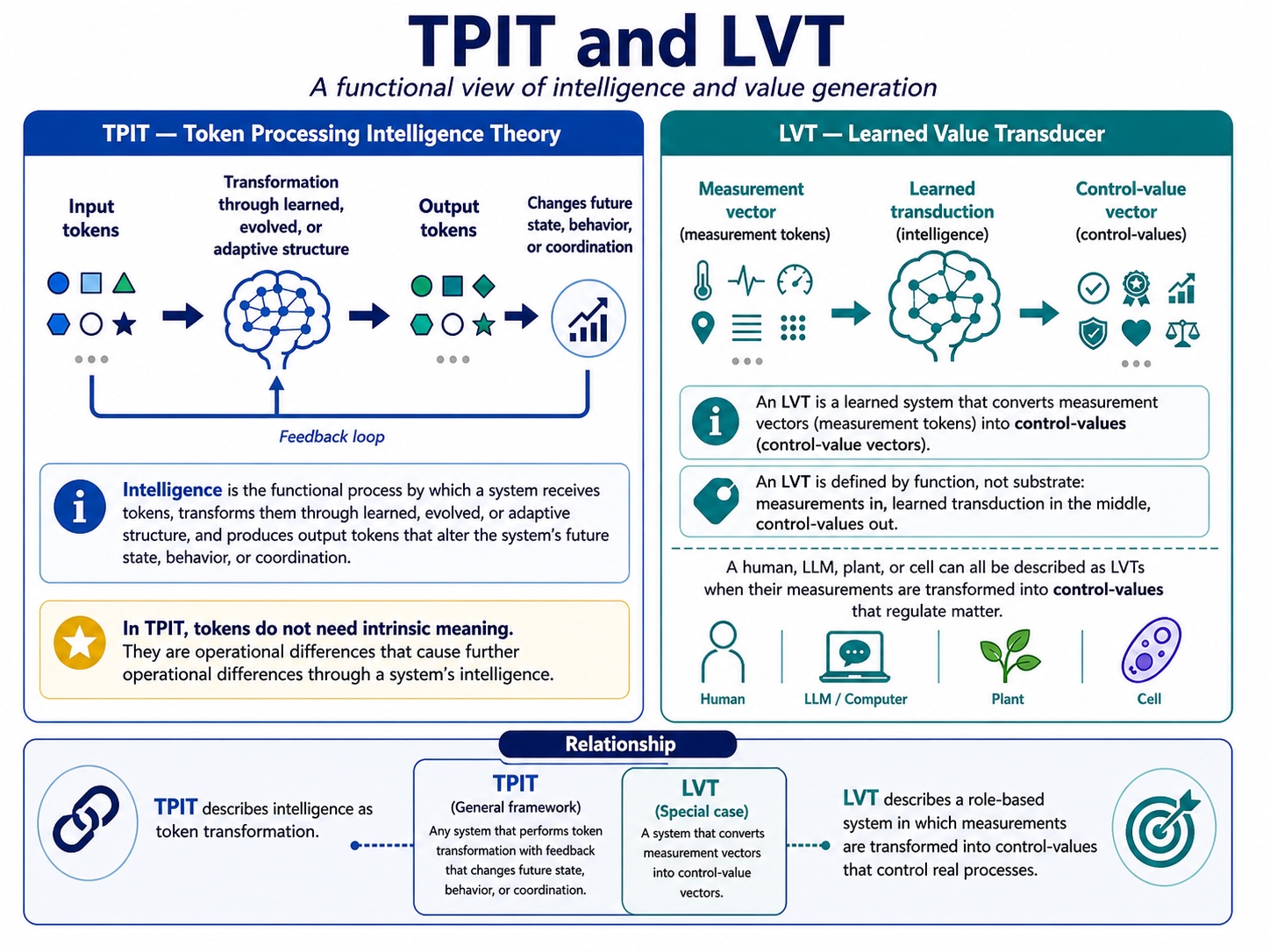
A red light does not need intrinsic meaning to matter. It matters because it changes trajectories. A pain signal matters because it changes posture and memory. A facial expression matters because it changes the next sentence. A price matters because it changes whether an exchange happens. In each case, a token is not important because it carries a mystical essence. It is important because it alters the future arrangement of actions.
On this account, intelligence is a way of turning possible collision into coordinated non-collision. The organism that sees the obstacle and avoids it has done this physically. The speaker who detects confusion and rephrases has done it semantically. The institution that turns vengeance into due process has done it socially. Prediction matters, but prediction is not the end of the story. The point of prediction is better routing.
Civilisation
The social world is made of routing layers
Human beings inhabit three-dimensional space, but cooperate in a much larger state-space: time, ownership, language, trust, role, status, expertise, law, money and memory. Each layer gives people another way not to collide.
Consider a queue. It is not physically impressive. It is simply a line of people who have accepted a rule about sequence. Yet that modest rule converts a crowd’s competing claims into order. Consider a calendar. It makes a room larger without moving its walls, because it spreads occupation through time. Consider ownership. It prevents every useful object from becoming a repeated contest. Consider apology. It is a repair protocol for status and trust after an interaction has gone wrong.
Society is full of these devices. Doors, lanes, forms, turn-taking, contracts, titles, timetables, passwords, borders, rituals and grammar all do the same kind of work. They create extra dimensions in which conflict can be routed before it becomes impact. They are not always just, and they are not always efficient, but their basic function is legible: make incompatible actions compatible enough for cooperation to continue.
This also explains why cooperation is more than niceness. Cooperation is a way of occupying different coordinates in a shared problem. One person steadies while another lifts. One designs while another builds. One teaches while another learns. One saves while another borrows. Roles prevent agents from trying to perform the same move at the same time. Language lets them name the difference before damage occurs.
Try the frame
From signal to response
Select a situation. The point is not the terminology. The point is the conversion: a sign of possible trouble becomes a change in conduct.
Signal: density, speed, distance and direction
Response: slow down, leave room, change path
Result: possible bodily collision becomes managed flow
The bottom line
What the lens gives us
The useful claim is not that everything is literally a crash. It is that many failures share the structure of collision: two trajectories become incompatible because a system did not detect, interpret or route them soon enough. The stronger the system, the earlier the conflict is transformed into a manageable difference.
That is why dimensions matter, why tokens matter, and why institutions matter. Dimensions provide routes. Tokens provide warnings and agreements. Institutions provide shared protocols. Intelligence is the moving part that converts one into another. A more intelligent system is not one that never touches anything. It is one that knows the difference between support and impact, between contact and damage, between friction and failure.
Seen this way, the work of civilisation is not to make life abstract or frictionless. It is to build better interfaces: enough separation to prevent harm, enough contact to allow cooperation, and enough shared meaning that most collisions are prevented before anyone has to call them collisions.