The creed
There are no sacred collisions.
There is contact, and there is damage.
There is meeting, and there is forced overlap.
There is difference, and there is destruction.
We choose passage.
The first lesson of our faith is learned from the line. In one dimension, every body is a barrier. The one who comes behind cannot pass the one ahead. There is no side-step, no bridge, no grace of angle. A single obstruction divides the world. The line teaches us what suffering becomes when there is no room for difference.
We do not worship the line. We study it because it reveals the primitive condition: beings moving with insufficient freedom, insufficient signal and insufficient mercy. A collision is not a blessing. It is a failure to make a path in time. The old world confused this failure with necessity. It called collision competition, destiny, toughness, nature, sometimes even virtue. We have learned to call it by its proper name.
The doctrine of dimensions
The world becomes kinder when it gains ways through.
Move the measure. Watch the doctrine change. Too few dimensions make every obstacle sovereign. Too many make meeting difficult. The holy condition is not infinite escape. It is disciplined freedom: enough room to avoid harm, enough structure to preserve contact.
Three dimensions are the ordinary mercy. A body can go around, over, under and behind. Obstacles remain real, but they are not always final.
From this we derive the Second Doctrine: a world is not saved by abolishing contact. Contact is how the foot finds the ground, how the hand steadies the child, how the voice reaches the listener, how the promise binds the future. Contact is not the enemy. The enemy is forced contact, unmanaged contact, contact without consent, contact without timing, contact without the intelligence to become gentle.
Our teachers once spoke of intelligence as if it were a private light inside the skull. We speak more plainly. Intelligence is the making of passage. It is the transformation of a sign into a safer next movement. The red light changes the vehicle. The pain signal changes the hand. The apology changes the room. The calendar changes the week. The law changes revenge into procedure. The prayer changes the worshipper before the worshipper damages the world.
We are often accused of being mystical because we speak of rituals. The accusation misunderstands us. We do not believe that a candle bends physics. We believe that a repeated act bends attention. We do not believe that a word commands the stars. We believe that a word can reorder a human being, and a reordered human being can alter the path of another. This is enough. A faith does not need to bypass reality in order to be real.
The daily offices
Rituals of non-collision
Our rituals are small because most damage begins small. They are not decorations. They are interfaces with the future. Select an office to see the practice and the collision it prevents.
The Threshold Pause
Before entering a room, a channel, a meeting or an argument, we pause long enough to ask what path is already in motion. The pause prevents the oldest collision: arriving as if nothing existed before us.
The city is our scripture in stone. Look closely and it becomes an arrangement of mercy. Pavements separate walking bodies from machines. Lanes keep speed from becoming murder. Doors make entry negotiable. Stairs and lifts give height a protocol. Signs let strangers coordinate without speaking. The city is not holy because it is clean or grand. It is holy where it lets many lives pass without impact.
So too with institutions. A court is a ritual for preventing vengeance from becoming a private crash. A contract is a ritual for preventing memory from becoming a battlefield. A market is a ritual for preventing desire from becoming seizure. A school is a ritual for preventing ignorance from colliding endlessly with reality. A hospital is a ritual for turning bodily emergency into ordered repair. These are not secular things opposed to religion. In our faith, they are religion made operational.
We do not deny conflict. We deny its glamour. Conflict tells us that two paths have met without a bridge. Sometimes a boundary must be defended. Sometimes a refusal is the only honest act. But even refusal has a right form. To refuse without cruelty is to preserve passage after difference. To win by crushing is to inherit a blocked world.
The examination
Where is the collision forming?
Our evening examination is not confession in the old punitive sense. It is maintenance. We ask where tomorrow is already becoming blocked, then we choose one act of passage.
What path am I forcing?
Who or what is already moving there?
What signal, delay, boundary or apology would create passage?
The hidden diagram
The technical relic beneath the faith
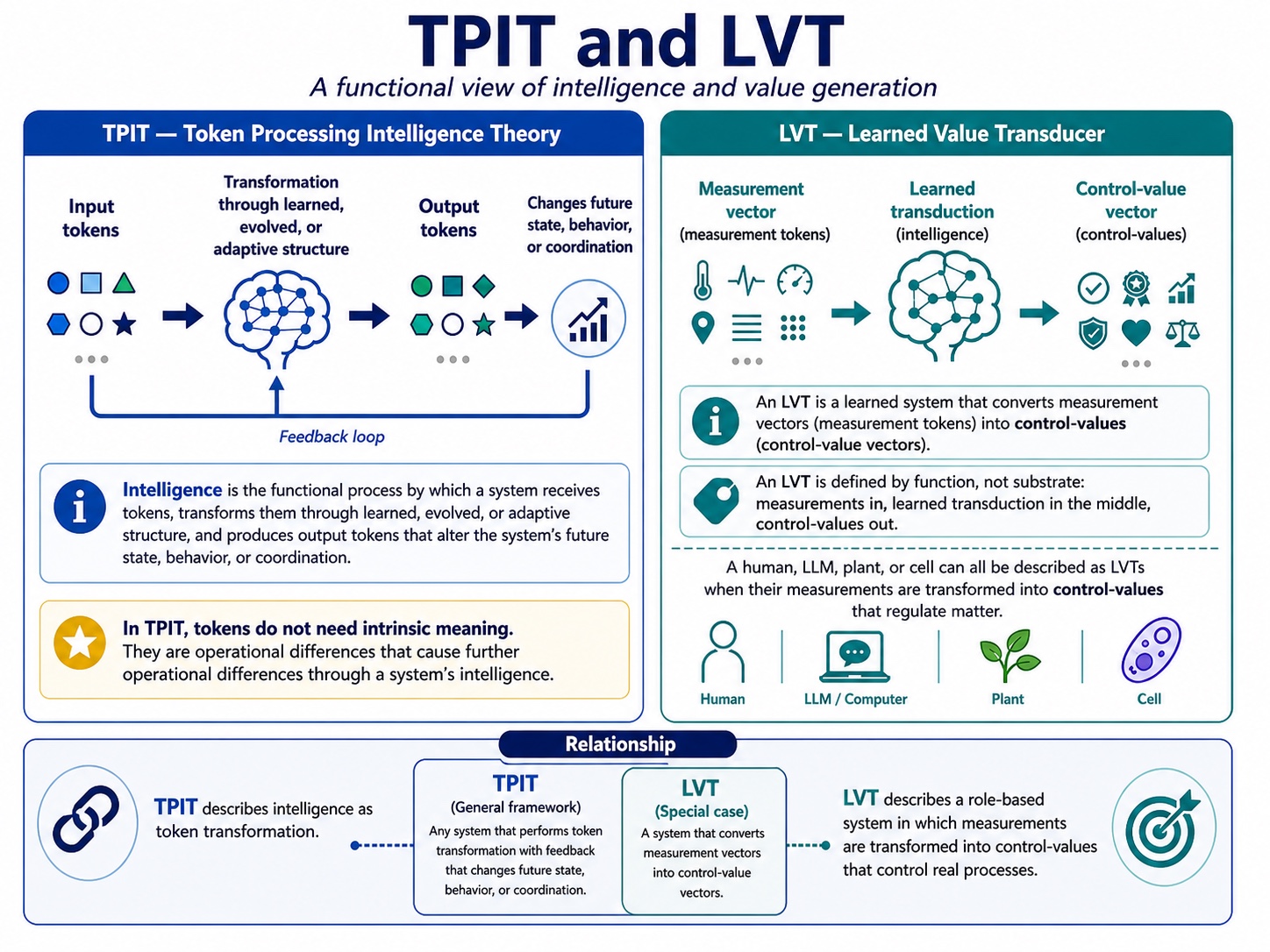
This article was born from a diagram about tokens, measurements, values and control. We keep it here as a relic, not because the believer needs its vocabulary, but because every faith has an anatomy beneath its liturgy. The plain teaching is this: signs become priorities; priorities become conduct; conduct changes the future.
We do not ask to pass through the world untouched. That would be loneliness disguised as purity. We ask for the harder grace: to touch without harm, to differ without crushing, to speak without invasion, to build without blockage, to leave room for the path we did not foresee.
The future is crowded. It will not become kind by accident. Every day we manufacture either collision or passage. Every interface, law, sentence, ritual and silence makes one of those futures more likely. This is why we practice. This is why we pause. This is why we signal. This is why we repair. The world is not short of force. It is short of ways through.