stage 01
New object
The discussion separated the second paper from the first. The first paper explains the field and the portal; the second asks how parties behave after learning to operate that portal.
This page records how the conversation moved from the Overton Field model into a separate PPE-style paper about political parties and capture.
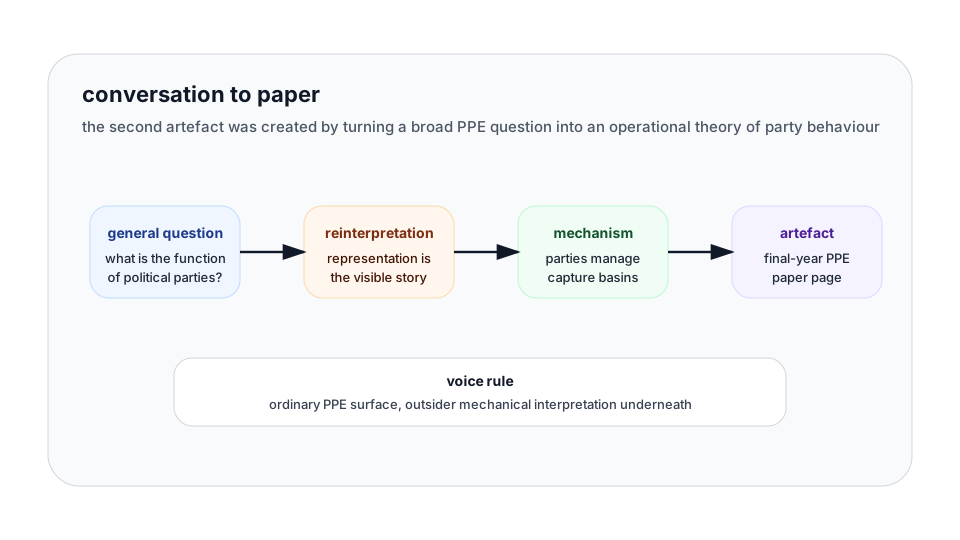
The first paper established the field model: voters move through a political field and election day acts as a portal that compresses complex states into admissible outputs. The second paper began when the focus shifted from the system itself to the way parties react to that system. The crucial move was to make it a different paper, not an extension of the mathematical one. The new paper needed a normal final-year PPE surface question, interpreted sharply.
The discussion separated the second paper from the first. The first paper explains the field and the portal; the second asks how parties behave after learning to operate that portal.
The working title became From Representation to Capture: Party Adaptation to Portal Politics, which names the transition from the official democratic story to the operational mechanism.
The paper needed a broad, ordinary question rather than a technical one. The chosen prompt was: What is the function of political parties?
The conventional answer was accepted but treated as incomplete. Representation, aggregation, recruitment, and accountability are visible functions; capture is the deeper operational function.
The paper was framed as a final-year PPE essay with an outsider’s structural eye: ordinary academic surface, but a mechanical reading of status, compression, and institutional output underneath.
The original single-paper site was reworked into a top-level collection called tasty-slop, with one card for each paper and a separate process page attached to each artefact.
The final paper was written as a self-contained PPE-style essay. It references recent field-theoretic work in the opening paragraph, then stands on its own. Earlier scaffolding from the previous model is not imported into the argument. The paper uses the field model only where it helps explain party adaptation, capture basins, salience management, negative identity, strategic vagueness, abstention, elite formation, and legitimacy.
index.html renders the party-adaptation paper.
tasty-slop links this paper with the original Overton Field paper.
This is the first rendered version of the second paper and the first version of the restructured collection site. Later versions can add a proper author note, tighter citations, more explicit empirical examples, or a downloadable PDF while preserving the two-page paper/process structure.