What is the function of political parties?
This paper treats the question as deliberately general. A conventional answer would identify representation, interest aggregation, candidate selection, government formation, and accountability. The argument below accepts that those are visible functions, but claims that they do not describe the deeper operational function of parties in mature two-party or two-bloc democracies. Under portal conditions, parties primarily function as systems of capture.
Abstract
Political parties are usually described as representative institutions. They organize interests, select candidates, structure electoral choice, form governments, and make democratic accountability possible. This paper argues that such descriptions are true but incomplete. In two-party or two-bloc systems, parties increasingly operate as capture-management systems. They do not simply represent voter preferences; they help produce the field in which preferences become electorally usable. Drawing on recent field-theoretic accounts of electoral politics, the paper interprets elections as portal events that compress high-dimensional political states into a small number of admissible ballot outputs. The function of parties is therefore not only to express social interests, but to route social energy through the portal. Parties manage salience, negative identity, coalition ambiguity, turnout, boundary voters, and institutional legitimacy so that dispersed and contradictory voter states are converted into governable electoral blocs. This does not make parties unnecessary to democracy. It makes them both necessary and dangerous: necessary because democracy requires organization and compression, dangerous because the same compression permits parties to claim representation where they have only achieved capture.
1. Introduction
Recent field-theoretic accounts of electoral politics have suggested that the classical image of parties competing inside a neutral public sphere is misleading. On this view, electoral democracy is better understood as a structured political field through which citizens move before being compressed, at election time, into a limited set of institutional outputs. The associated model, developed in The Overton Field, treats elections as portal events: moments at which complex voter states must become simple ballot tokens.
This paper takes that model as a provocation, but not as a dependency. Its question is older and more general: what is the function of political parties? The ordinary answer is familiar. Parties represent interests, aggregate preferences, recruit leaders, organize legislatures, produce governments, and make voters able to hold rulers accountable. These claims are not wrong. They describe what parties are supposed to do and, in many cases, what they partly do.
They are nevertheless incomplete because they describe parties in the language of democratic justification rather than political operation. Representation is the respectable word. Capture is the mechanism. A party that wins an election does not transmit the whole complexity of its voters into government. It receives a simplified institutional signal generated by a voting system. The party then interprets that signal as mandate, legitimacy, or consent. Between the voter’s actual political state and the party’s claim to represent that voter lies a process of compression.
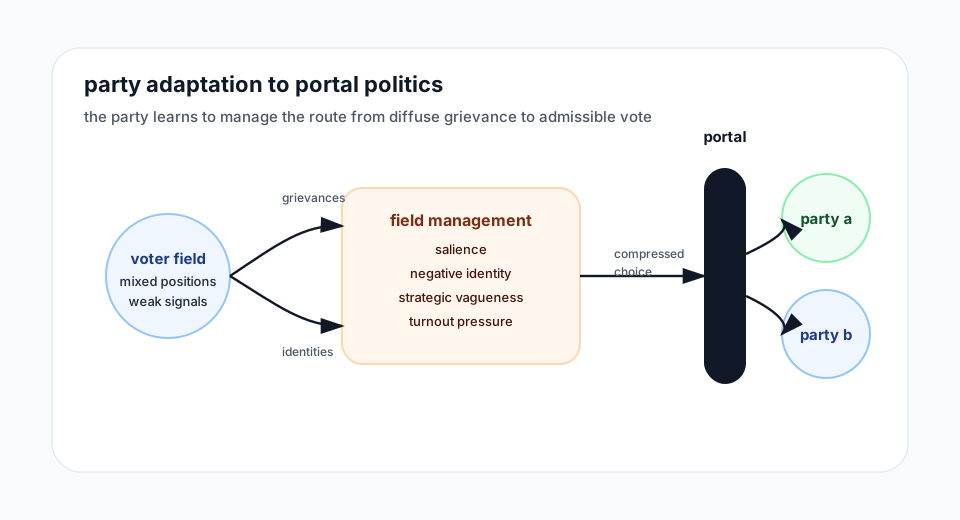
The central argument is that political parties function as capture-management systems. They do not merely wait for voter preferences to appear and then represent them. They shape what voters notice, which grievances become salient, which enemies become intolerable, which contradictions can be hidden, which coalitions can be made emotionally coherent, and which votes become institutionally useful. In a two-party system, parties adapt to the portal by learning how to route complex social material into one of two dominant outputs.
2. The orthodox answer
The orthodox answer begins with representation. Modern mass democracy is too large for citizens to govern directly, so parties reduce complexity. They give voters labels, programmes, candidates, and expectations. A voter who cannot inspect every policy detail can use party identity as a shorthand. A legislature that would otherwise contain hundreds of isolated representatives can be organized into stable blocs. A government that would otherwise be personally improvised can be formed from party leadership and party discipline.
Parties also aggregate interests. Farmers, workers, property owners, public-sector employees, pensioners, graduates, homeowners, tenants, religious groups, regions, professions, and cultural factions do not enter parliament as raw social categories. They are assembled into coalitions. The party turns social plurality into a governable political offer. It makes compromise possible before the election rather than after it. A manifesto is not merely a list of promises; it is an attempted settlement among groups that would otherwise pull in different directions.
Parties also recruit and filter political personnel. They select candidates, train spokespeople, supply donors, build campaign organizations, discipline legislators, and provide a route from ambition to office. This filtering role is often described as a practical necessity. Voters cannot vet every possible ruler from scratch. Parties supply reputational structure. They tell voters which individuals are admissible as serious political actors.
Finally, parties make accountability more manageable. A voter may not understand every administrative failure, but can punish the party in government. A governing party can claim responsibility for its programme; an opposition party can offer itself as the alternative. Party competition therefore structures blame and replacement. Without parties, democratic accountability might dissolve into personalism, localism, or administrative opacity.
| Orthodox function | Official democratic purpose | Operational underside |
|---|---|---|
| Representation | Express voter interests. | Make voters legible as a bloc. |
| Aggregation | Combine social demands into programmes. | Suppress contradictions inside a usable coalition. |
| Recruitment | Select competent candidates. | Filter ambition through party loyalty and social fluency. |
| Accountability | Let voters punish or reward government. | Convert diffuse judgement into a binary change/no-change signal. |
The orthodox account therefore has real explanatory power. It explains why parties emerged, why they endure, and why democracies find it hard to operate without them. Yet it tends to describe the party from the perspective of the constitution, the civics textbook, or the party’s own self-description. It tells us what parties do for democracy. It says less about what parties do to voters.
3. Why representation is incomplete
The representation model assumes, too easily, that voter preferences exist prior to party competition and are then transmitted into government. This is sometimes true in a weak sense. People do have interests, memories, attachments, injuries, hopes, and fears before parties speak to them. But those materials are not yet a party preference. They are politically underdetermined. The same rent pressure can become a demand for housebuilding, rent control, anti-landlord politics, anti-immigration politics, anti-city resentment, anti-government anger, or simple withdrawal from politics. The same experience has several possible electoral meanings.
Parties operate precisely in that space of underdetermination. They do not merely receive interests; they interpret them. They tell voters what their experiences mean, who is responsible, which emotions are legitimate, which facts matter, and which coalition can redeem the situation. A party can therefore represent a voter only after participating in the construction of the voter’s political meaning.
This is why the question “what do voters really want?” is often less useful than it appears. Voters do not approach politics as fully coherent constitutional theorists. They approach it with mixed pressures and partial interpretations. A party succeeds when it supplies a frame that makes those pressures travel together. It says, in effect: your wage anxiety, your disgust at corruption, your cultural discomfort, your pride in place, and your fear of the other side all belong to the same story. Vote here.
The insufficiency becomes sharper in two-party systems. The voter’s internal state may be high-dimensional, but the ballot is low-dimensional. A person can dislike both parties, agree with each on different issues, mistrust the whole process, and still cast one vote. The vote is not a full statement of belief. It is the output accepted by the institution. The party that receives it will treat it as support, but the voter may have meant avoidance, resignation, tactical calculation, or lesser-evil selection.
This gap between inner political complexity and institutional output is the space in which party adaptation occurs. Parties learn that a voter does not have to be persuaded in the philosophical sense. The voter only has to be routed. A campaign does not need to resolve every contradiction in the coalition. It needs to prevent those contradictions from becoming decisive before the portal is reached.
4. Capture as function
Capture, in this paper, does not mean fraud, coercion, or conspiracy. It means the successful routing of a voter state into an institutional output. A party captures a voter when that voter’s mixed political condition is converted into a ballot token for the party. The capture may be enthusiastic, reluctant, tactical, habitual, fearful, tribal, or negative. What matters operationally is not the purity of the voter’s intention but the institutional result.
The language of capture is useful because it avoids a sentimental account of representation. Representation suggests a mirror. Capture suggests a mechanism. The party is not a passive reflector of pre-existing social reality. It is an active structure that attracts, filters, simplifies, and converts. It takes a population distributed across many dimensions and tries to make enough of that distribution fall into its basin at election time.
In simple field terms, let \(\Omega_T\) be the political field at election time and let \(\Pi_T\) be the portal map from political states to ballot outputs. A party’s capture basin is the set of states that the portal maps to that party:
The party’s task is to increase the measure of its basin, not necessarily to make every captured voter ideologically identical. If \(\mu_T\) is the distribution of voter states, the party’s electoral result is determined by the mass of the field routed into its basin:
This formalism is deliberately simple, but it clarifies the political point. Parties seek to enlarge, defend, and stabilize their basins of capture. They may do so by attracting voters, repelling them from the opponent, increasing turnout among likely supporters, suppressing turnout among opponents, absorbing issues from insurgent movements, or making rival choices appear impossible. These are different campaign techniques, but they share the same structural function.
The concept also explains why parties can be ideologically inconsistent and still politically effective. Consistency is valuable only when it helps maintain capture. When consistency narrows the basin, parties often prefer ambiguity. When ambiguity weakens credibility, they prefer clarity. When clarity alienates a subgroup, they invent symbolic language broad enough to allow different supporters to hear different things. The party’s coherence is therefore not primarily philosophical. It is coalitional.
5. Party adaptation
Once parties understand the portal structure, they adapt to it. They become less like ideological societies and more like field-management organizations. This does not mean that ideology disappears. Ideology remains one of the resources from which parties build attraction. But the party’s strategic intelligence shifts toward managing the conditions under which voters will be captured.
Salience management
The first adaptation is salience management. Since voters hold many concerns at once, the decisive question is often not what they believe, but which belief is activated at the moment of choice. A voter may care about wages, immigration, healthcare, free speech, corruption, taxes, housing, local identity, and foreign policy. The party does not need to win every coordinate. It needs to make a favourable coordinate dominate when the portal arrives.
This is why campaigns fight over agenda rather than merely over answers. To control salience is to control which part of the voter becomes electorally operative. If the election is about public services, one party may gain. If it is about border control, another may gain. If it is about competence, corruption, identity, inflation, or fear of instability, the field changes shape. Parties adapt by trying to define what the election is “really” about.
Negative identity
The second adaptation is negative identity. In a two-pole system, repulsion from one party can capture voters for the other. A party does not have to be loved if its opponent can be made intolerable. This is particularly efficient because negative emotions often travel across coalition boundaries more easily than detailed policy agreement. Supporters who disagree on economics, culture, and institutions may still unite around the claim that the other side must not govern.
Negative identity turns the rival party into a moral object rather than merely a political competitor. The opponent becomes chaotic, cruel, corrupt, extremist, decadent, authoritarian, unpatriotic, elitist, dangerous, or unserious. Such language is not accidental excess. It helps alter the basin boundary. A voter near the boundary can be captured by fear of crossing it.
Strategic vagueness
The third adaptation is strategic vagueness. Parties must hold together voters who do not actually agree. A precise programme may satisfy one faction while exposing another to the cost of coalition. Vagueness can therefore be a rational technology of capture. It allows different voters to project different hopes onto the same party. It postpones conflict until after the portal has done its work.
This is often mistaken for mere cynicism. It is more structural than that. Under low-resolution electoral conditions, excessive honesty can be punished because it makes the coalition’s internal contradictions visible too early. The successful party learns which commitments must be clear, which must be symbolic, and which must remain unresolved. It communicates enough to attract, but not always enough to specify.
Boundary voters and abstention
The fourth adaptation is boundary management. Campaigns often focus on voters near the edge between basins, because small movements there can change the institutional result. A voter deeply inside a party’s basin may be emotionally valuable but strategically redundant. A boundary voter is more valuable because a small change in salience, trust, disgust, or fear can alter the output.
Abstention is part of the same logic. A party may win by attracting voters from the opponent, but it may also win by causing potential opponents not to pass through the portal at all. Disillusion, disgust, procedural difficulty, low enthusiasm, or the belief that “they are all the same” can shift the distribution without direct conversion. Non-capture is therefore politically active. It is not simply absence.
Absorption of insurgencies
The fifth adaptation is absorption. New movements threaten established parties when they create alternative basins of capture. A dominant party can respond by adopting the movement’s language, partially conceding its issue, recruiting its personnel, stigmatizing it as irresponsible, or changing the electoral stakes so that supporters return to the main pole. The aim is not always to defeat the insurgency directly. It is to prevent the insurgency from becoming an independent portal route.
This is one reason two-party systems can appear both flexible and frozen. They absorb pressure without necessarily changing the underlying portal. New issues enter the system, but they are often translated into old party competition. The field deforms, but the dominant outputs remain stable.
6. Elite formation
Political parties are not abstract machines. They are operated by people, and those people are often selected through institutions that already reward field fluency. Elite educational and professional environments train participants to read signals, control tone, manage ambiguity, avoid socially costly sincerity, and convert complex belief into acceptable output. The lesson is rarely stated openly. It is learned by pressure.
This matters because the party mind is not formed only inside party headquarters. It is rehearsed in schools, universities, internships, think tanks, media studios, student societies, and informal networks where ambitious people learn that winning often means understanding the room before stating the truth. They learn which positions are respectable, which jokes survive, which forms of dissent are rewarded as clever, and which forms are punished as gauche. They learn compression before they learn government.
From inside such environments, politics is often described in elevated terms: public service, leadership, argument, responsibility, moderation, judgement. Those descriptions are not wholly false. But they can conceal a more mechanical education in portal behaviour. The successful operator learns how to make a self legible to the institution. Later, in party politics, the same operator learns how to make a public legible to the party.
There is a particular analytical advantage in not fitting smoothly into this social field. Someone who is not naturally absorbed by elite codes may notice the machinery more clearly. The point is not that social awkwardness produces moral purity or automatic insight. It does not. The point is narrower: when the codes do not feel natural, they are easier to see as codes. What others experience as atmosphere can appear as structure.
This gives the question about parties a second layer. The party does to the electorate what elite institutions do to their entrants. It receives unruly human complexity and teaches it to produce acceptable outputs. The language is different, but the operation is similar: sort, signal, compress, route, and reward. The function of the party is therefore not only representative. It is formative. It produces the kind of voter it can then claim to represent.
7. Democratic legitimacy
The capture model does not imply that parties are dispensable. On the contrary, it explains why they are so difficult to escape. Democracy needs organization. It needs candidates, programmes, coordination, responsibility, and decision. A democracy without parties would still need some mechanism for transforming social plurality into institutional action. If that mechanism were not called a party, it would likely reproduce many party functions under another name.
The problem is therefore not that parties compress. Some compression is unavoidable. The problem is that parties often convert compression into exaggerated claims of representation. A party wins a majority of seats, or even a plurality of votes, and then speaks as if it has received a coherent instruction from the people. But the underlying vote may contain enthusiasm, fear, hatred of the alternative, tactical calculation, habit, resignation, and accidental turnout effects. The mandate is cleaner than the field that produced it.
Democratic legitimacy depends on acknowledging this gap. A party may be legitimately authorized to govern without being entitled to pretend that it fully represents the inner political complexity of its voters. Elections authorize rule; they do not reveal the soul of the electorate. The vote is a control signal, not a confession.
This distinction matters because parties often use electoral victory to close debate. Once the portal has produced an output, the winning party claims that the question has been settled. In one sense, it has. The institutional question of who governs has been answered. But the political field has not disappeared. The losing voters remain. The reluctant supporters remain. The abstainers remain. The contradictions inside the winning coalition remain. The portal produces government, not metaphysical unity.
8. Objections
The first objection is that “capture” is too cynical. Parties often do represent real interests. Labour parties have represented workers, conservative parties have represented property and order, liberal parties have represented civil rights and markets, green parties have represented ecological concern, and nationalist parties have represented claims of sovereignty or identity. The capture model can accept this. Its point is not that representation is fake. Its point is that representation is operationally mediated by capture. A party may represent interests by first making them capturable.
The second objection is that voters are not particles. They think, deliberate, change their minds, resist manipulation, and sometimes punish parties sharply. This is also true. The particle language is a model of movement through a field, not a denial of agency. Models simplify in order to reveal structure. A voter can be an agent and still be subject to institutional compression. Agency does not abolish the portal.
The third objection is that multi-party and proportional systems weaken the argument. They do weaken the strict two-pole version. Where the portal allows more outputs, it preserves more information from the underlying field. But even multi-party systems require coalition formation, threshold effects, party labels, strategic voting, and governing blocs. They reduce compression; they do not eliminate it. The two-party case is the clearest form of a more general democratic problem.
The fourth objection is that the model underestimates ideology. Parties are not only machines. They contain beliefs, histories, loyalties, moral projects, and genuine conflicts about the good society. This is true, but it does not refute the model. Ideology is one of the strongest ways to produce durable capture. It gives voters a story in which their interests and identities cohere. The more powerful the ideology, the more effectively it can turn a field of experience into a route toward action.
9. Conclusion
The function of political parties is not exhausted by representation. Parties represent, aggregate, recruit, govern, and structure accountability, but these functions sit on top of a deeper operation. In electoral democracies, especially two-party or two-bloc systems, parties convert a complex political field into institutional outputs. They do this by managing salience, constructing negative identity, maintaining ambiguity, targeting basin boundaries, absorbing insurgencies, and defending the legitimacy of the portal.
To say that parties capture voters is not to say that democracy is meaningless. It is to say that democracy works through machinery. The voter’s political state is richer than the vote. The party’s mandate is simpler than the coalition that produced it. The election settles who governs, but it does so by compressing complexity into a small number of admissible signals.
A good answer to the question “What is the function of political parties?” must therefore hold two truths together. Parties are necessary because mass democracy cannot operate without structures of organization and compression. Parties are dangerous because the same structures allow them to mistake capture for representation. The party is not simply the voice of the voter. It is the machine that teaches the voter how to become a vote.
References
Burke, Edmund. 1774. “Speech to the Electors of Bristol.”
Downs, Anthony. 1957. An Economic Theory of Democracy. New York: Harper.
Duverger, Maurice. 1954. Political Parties: Their Organization and Activity in the Modern State. London: Methuen.
Katz, Richard S., and Peter Mair. 1995. “Changing Models of Party Organization and Party Democracy: The Emergence of the Cartel Party.” Party Politics 1(1): 5–28.
Kirchheimer, Otto. 1966. “The Transformation of the Western European Party Systems.” In Joseph LaPalombara and Myron Weiner, eds., Political Parties and Political Development. Princeton: Princeton University Press.
Michels, Robert. 1911. Political Parties: A Sociological Study of the Oligarchical Tendencies of Modern Democracy.
Panebianco, Angelo. 1988. Political Parties: Organization and Power. Cambridge: Cambridge University Press.
Sartori, Giovanni. 1976. Parties and Party Systems: A Framework for Analysis. Cambridge: Cambridge University Press.
Schattschneider, E. E. 1942. Party Government. New York: Farrar and Rinehart.
Schumpeter, Joseph A. 1942. Capitalism, Socialism and Democracy. New York: Harper.