Manson and Epstein are easy to misread because they arrive in the imagination wearing different costumes. Charles Manson looks like the failed outlaw prophet: prison dirt, hippie debris, guitar strings, desert mythology, sex, drugs, apocalypse, and murder. Jeffrey Epstein looks like the insulated operator: sweaters, private jets, townhouses, islands, legal agreements, philanthropy, science talk, finance talk, and elite rooms. One seems primitive, the other sophisticated. One seems like a lunatic at the edge of civilization, the other like a man who knew how to pass through its highest doors. But that contrast is partly theatrical. Beneath it, they belong to the same predatory type: the man who learns the hidden hunger in another person and then gives that hunger a language that leads back to himself.
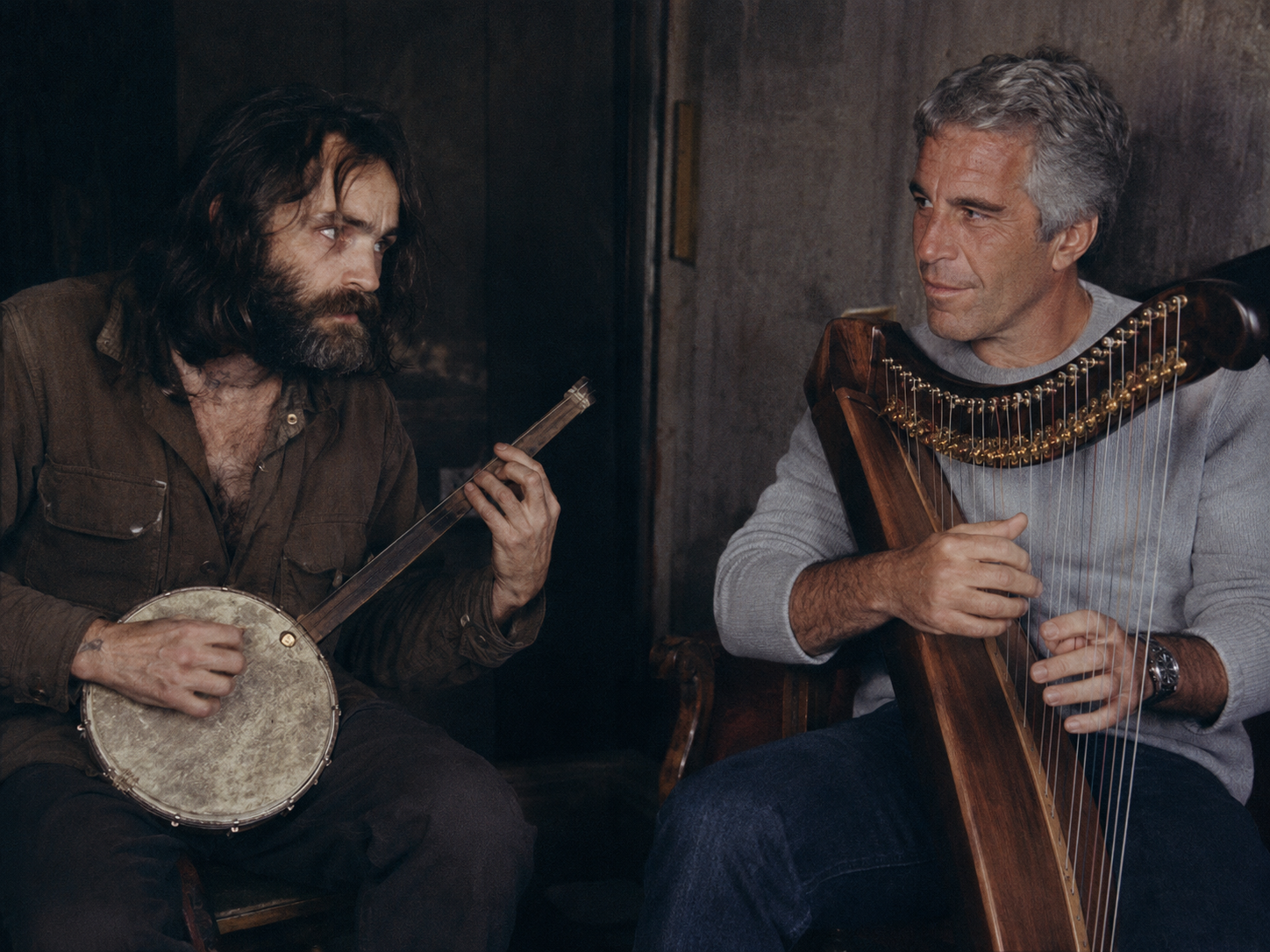
The image of Manson with a one-string banjo and Epstein with a harp captures the difference better than a clinical comparison would. Manson’s language was crude, narrow, and repetitive, but that was the source of its force. He did not need range. He needed fixation. He played a small number of notes until they became a world: family, love, freedom, death, betrayal, race, revolution, prophecy, release. His power was not intellectual architecture. It was compression. The world was false; Charlie was true. Parents were dead; the Family was alive. Morality was slavery; surrender was liberation. Violence was not crime; it was revelation. The one-string banjo is not merely a sign of poverty or crudeness. It is a theory of control. Narrow the vocabulary and you narrow reality.
Epstein’s harp worked differently. His language was not one note repeated into trance, but many strings plucked according to the listener. To one girl or woman, he could speak in the language of work: massage, money, travel, opportunity, help with bills. To another, he could speak in the language of exceptionalism: you are mature, you are different, you understand the adult world. To another, he could speak in the language of aspiration: modeling, introductions, universities, famous people, a life beyond ordinary limits. To another, he could speak in the language of rescue: I can protect you, I can help you, I see something in you. To people already inside his system, he could speak in the language of normalization: this is how things work, do not be dramatic, everyone understands, discretion is expected. The harp is the instrument of modulation. Epstein did not need everyone to hear the same song. He needed each person to hear the version that made compliance feel personally intelligible.
This is why the question of education is misleading. Manson’s lack of education does not make his influence mysterious, and Epstein’s proximity to elite institutions does not make him fundamentally more refined. Both were under-legitimated men who manufactured authority through performance. Manson turned outsider status into proof of revelation. He had not been corrupted by the respectable world; therefore, he could claim to see through it. Epstein turned credential gaps into mystique. He performed intelligence, access, and financial power so fluently that people treated him as if his importance had already been established elsewhere. In both cases, language substituted for legitimate authority. Manson performed the prophet. Epstein performed the patron. Both performances asked the listener to accept that the man knew the real rules.
The con is the central structure. Manson was not simply a cult leader who somehow hypnotized sensible people. He was a con man who selected his marks carefully and adapted the pitch. He did not sell the same thing to everyone at first. To some, he sold family. To others, rebellion. To others, sex without shame. To others, revenge against the world. To others, the glamour of being outside ordinary life. Epstein’s con operated in a parallel but inverted direction. Manson offered escape from the world below its moral floor. Epstein offered entrance into the world above its ordinary ceiling. Manson said, in effect, come outside civilization. Epstein said, come above it. Both sold passage into a place where normal rules supposedly no longer applied.
That is why they are more alike than their social settings suggest. Both were adaptive language operators. Both began by reading the mark. What does this person lack? What do they resent? What do they want to be told about themselves? What shame can be renamed? What desire can be given permission? What boundary can be made to feel childish, bourgeois, provincial, dramatic, or disloyal? Once the answer was found, the pitch could be shaped. The surface offer changed, but the destination remained the same: dependency, compliance, silence, and moral disorientation.
Their shared talent was not eloquence in the respectable sense. It was frame control. They could rename the room while standing inside it. Manson could make domination sound like love, degradation sound like freedom, violence sound like awakening, and obedience sound like authenticity. Epstein could make exploitation sound like employment, recruitment sound like opportunity, payment sound like generosity, trafficking sound like travel, and secrecy sound like sophistication. The victim or follower was not asked to assent to the whole evil at once. They were led through smaller words, softer words, words that made resistance feel disproportionate. Why object to a massage, a favor, a trip, a family, a song, a secret, an introduction, a gift?
This is where the shamanic archetype enters, though only in its corrupted form. The old shaman is the person who claims to know the invisible rules: the meaning of dreams, the anger of spirits, the source of illness, the proper ritual, the taboo that must be obeyed. In a healthy social form, such a figure is constrained by the group and serves a communal function. He interprets fear, grief, sickness, and uncertainty. But the predatory version privatizes that symbolic power. He makes the mystery point back to himself. He becomes the gate, the interpreter, the exception, the one through whom reality must pass. Manson’s version was obviously pseudo-shamanic: trance, song, sex, drugs, death, desert, prophecy. Epstein’s was secular and modern: networks, money, information, elite access, legal insulation, reputational danger. Manson claimed to know what the world really meant. Epstein claimed to know how the world really worked.
Nietzsche sharpens the point if used carefully. Both men acted like counterfeit Nietzscheans. They treated inherited morality as a costume worn by weaker people, but they did not overcome themselves or create higher values. They merely dissolved limits so their appetites could rule. Manson turned transgression into initiation: to cross the line was to awaken from the lie and prove loyalty. Epstein turned transgression into sophistication: to cross the line was to enter the adult, protected, elite world where ordinary shame supposedly did not apply. Both sold a degraded version of being beyond good and evil. What they actually offered was not freedom from the herd, but entrance into a smaller and uglier herd organized around themselves.
The difference between them remains real, but it is aesthetic and operational rather than moral. Manson’s system was hot, face-to-face, theatrical, tribal, and ecstatic. Epstein’s was cool, compartmentalized, transactional, networked, and bureaucratic. Manson collapsed reality into one myth. Epstein multiplied realities and assigned different people different scripts. Manson’s world looked insane from the outside. Epstein’s world was designed to look administratively ordinary from the inside. Manson’s language was a chant. Epstein’s was a calendar. Manson used the one-string banjo to reduce the world to Charlie. Epstein used the harp to make many worlds resonate around Jeffrey.
That is the deepest comparison. Manson and Epstein were not opposites. They were mirror images of the same predatory talent: one selling escape from the world and the other selling entrance into it. One dragged people downward into a fake primal truth; the other lifted people upward into a fake elite permission. One wore dirt and apocalypse; the other wore money and discretion. But both claimed access to hidden rules, both used language to make themselves necessary intermediaries, and both converted other people’s vulnerability into obedience. Manson had one string and made it sound like the end of the world. Epstein had many strings and made exploitation sound like an invitation.