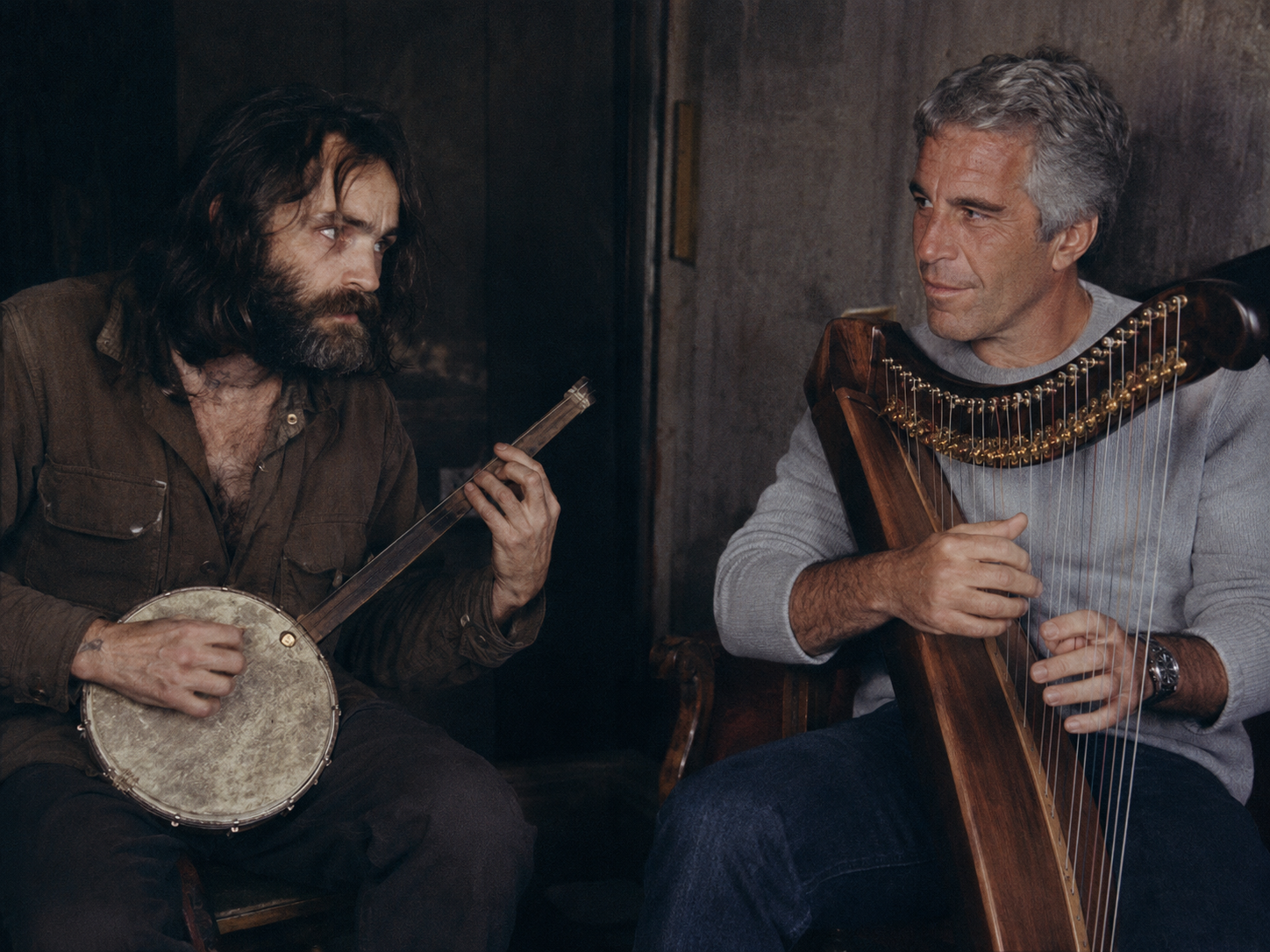
The image of Manson with a one-string banjo and Epstein with a harp is not a joke about musical taste. It is a way of seeing their difference without mistaking it for a difference in kind. Manson had one string. Epstein had many. Manson played a narrow instrument with terrible force. Epstein played a wide instrument with fluent variation. The one-string banjo and the harp do not name two species of predator. They name two ranges of the same faculty. Both men could play. Both knew how to make a person vibrate at the pitch that would bring them closer.
Manson’s single string was not stupidity. It was concentration. He did not need a large vocabulary of social worlds because the people he gathered around him were already moving away from ordinary society. He played the note of escape. He played family, freedom, sex, love, rejection, revenge, prophecy, and the end of the false world as if they were all one sound. The point was not argument. The point was resonance. He found alienated people and made their alienation sound like election. He found wounded people and made their wound sound like knowledge. He found people who wanted to leave the world and made himself the door.
Epstein’s harp was not refinement in the moral sense. It was range. He could play money, glamour, pity, opportunity, secrecy, adulthood, sophistication, intelligence, access, social climbing, legal ambiguity, and protection. He did not have to make everyone hear the same note. His environment required many notes because his targets and accomplices moved through more complicated rooms. To one person the music could sound like help. To another it could sound like work. To another it could sound like mentorship. To another it could sound like entry into the real world behind the official one. He did not have one chant. He had many registers, and he knew when to pluck each string.
That is why the comparison should not be reduced to a con. A con implies that the whole thing is false, that the operator only pretends to possess power. But these men did possess power. They were not fake shamans in the simple sense. They were real shamans of degraded worlds, real handlers of invisible forces: shame, hunger, fantasy, ambition, rebellion, loneliness, status, fear, dependency, and exemption. The horror is not that they pretended to influence people. The horror is that they really could influence people, and they used that faculty to bend the world toward themselves.
In older language, a shaman is not merely someone who lies about spirits. A shaman is someone who crosses into the invisible and returns with authority over the visible. In a modern setting, the invisible is not only gods and ghosts. It is the hidden rule, the real access, the forbidden permission, the unspoken desire, the secret name of what a person wants. Manson and Epstein both operated there. Manson said, in effect, that he knew what society was hiding and how to get outside it. Epstein said, in effect, that he knew how the protected world really worked and how to get inside it. Outside and inside were opposite directions, but the promise was the same: follow me and the ordinary rules will no longer bind you.
This is where Nietzsche’s will to power enters. Will to power is not simply a desire to dominate in the crude political sense. It is the pressure of life to shape, interpret, command, rank, and impose form. Manson and Epstein were not philosophers of this force. They were embodiments of it in its predatory social form. They did not merely want pleasure. They wanted arrangement. They wanted a field around them in which others acquired meaning by relation to them. Their language was not decoration. It was world-making. It created the private weather in which their authority could feel natural.
Manson made his world by narrowing reality. Epstein made his world by multiplying it. Manson’s one string pulled people into a single myth where Charlie became the interpreter of everything. Epstein’s many strings let him appear differently to different people while keeping the same center hidden. Manson’s mastery was reduction. Epstein’s mastery was modulation. But reduction and modulation are techniques of the same art. Each man understood that people are not moved first by facts. They are moved by the story in which facts become meaningful.
This is why formal education is not the decisive issue. Education teaches certain forms of language, but it does not create mastery of desire. Manson did not need degrees because his stage was the commune, the prison memory, the song, the drugged room, the desert, the wounded circle. Epstein did not need the full legitimacy he performed because his stage was the office, the airplane, the mansion, the appointment book, the donation, the introduction, the settlement. Each man knew the language of his stage. Each played the instrument his world gave him.
The terrible commonality is that both men turned other people into instruments too. The listener became part of the music. The girl, the follower, the assistant, the recruiter, the guest, the believer, the ambitious visitor, the frightened dependent person: each was given a note to play. That is the deeper meaning of the banjo and the harp. The instrument is not only what the predator holds. It is the social field he creates. Manson made a crude music because his world was crude, but he played it well. Epstein made a more elaborate music because his world was elaborate, and he played that well too.
They were therefore not opposites, and not merely parallels. They were the same object under different conditions. One appeared where the fantasy was escape from civilization. The other appeared where the fantasy was admission into civilization’s inner chamber. One played one string. One played many. The difference matters, but only as technique. The will underneath was the same will: to read the invisible, name it, command it, and make others move to the sound.