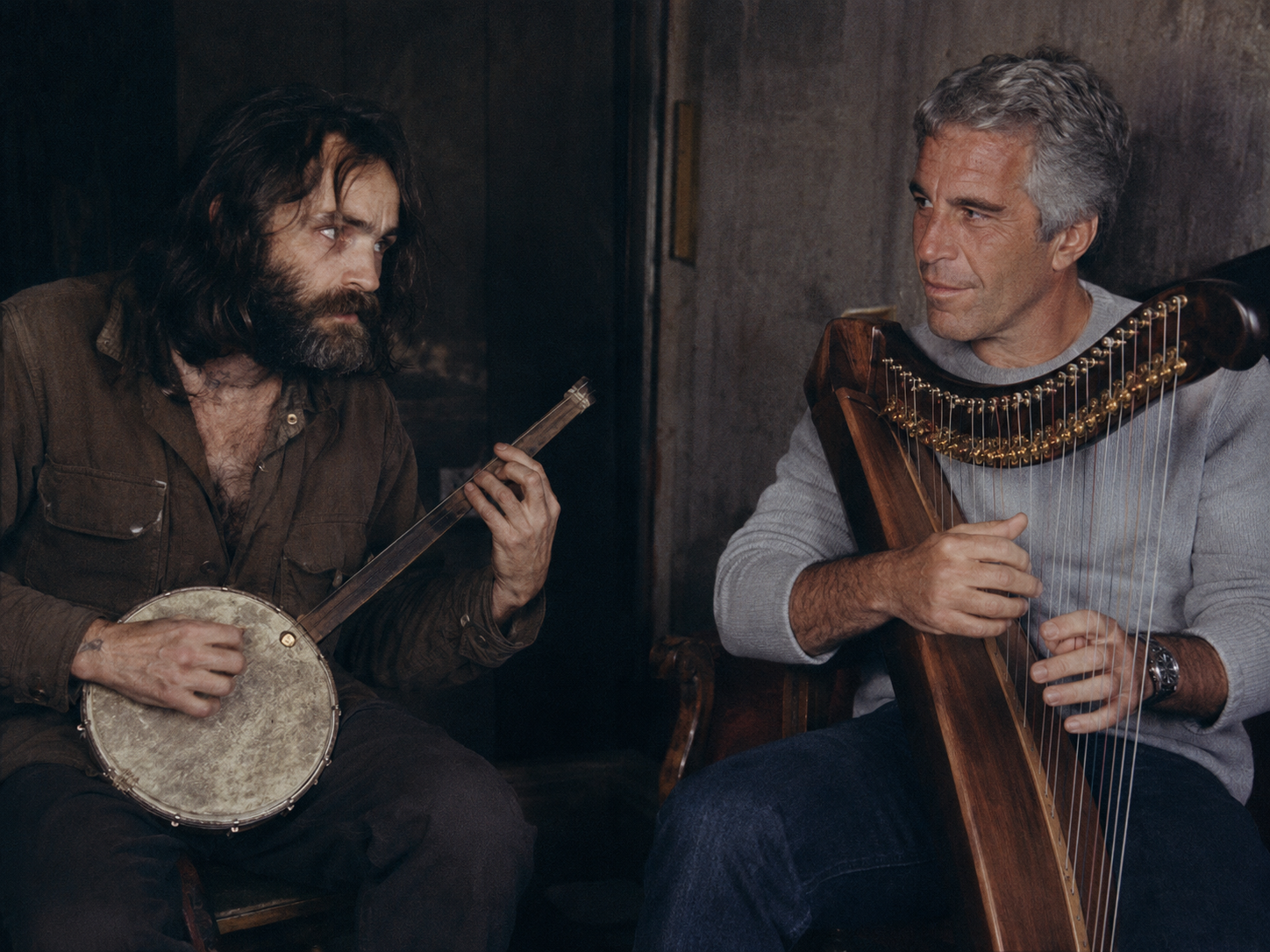
The mistake is to call men like Charles Manson and Jeffrey Epstein counterfeit. That word is too comforting. A counterfeit is fake money. It resembles value while lacking it. But the power these men exercised was not fake. It was real power, acting in the world, entering other people’s bodies, choices, loyalties, fears, desires, and speech. The horror is not that they pretended to be something. The horror is that they were something. They were not failed shamans or fraudulent shamans. They were real shamans in the dark sense: figures who entered the unstable space between language and reality and discovered that a person who can rename the world can make other people live inside the new name. The one-string banjo and the harp are not symbols of two different men. They are symbols of one object appearing through two instruments.
The object is will to power. Not will to power as a slogan, and not merely the appetite to boss people around, but will to power as the drive to impose form, to interpret, to arrange the field, to create the terms under which other people experience reality. A man of this type does not simply want things. He wants the world around his wanting to change shape. He wants his desire to become a climate. He wants other people to stop experiencing his desire as an intrusion and begin experiencing it as fate, initiation, truth, opportunity, love, freedom, sophistication, revelation, or necessity. This is why ordinary moral language often arrives too late. By the time the visible crime appears, the earlier crime has already happened in language. The world has been renamed.
Manson and Epstein were instances of the same object because both functioned as real mediators. They placed themselves between other people and a hidden order. Manson’s hidden order was below the official world. Epstein’s hidden order was above it. Manson offered descent: out of the family, out of school, out of jobs, out of bourgeois shame, out of law, out of the ordinary self, into the desert, the song, the body, the Family, the revelation. Epstein offered ascent: into the room, into money, into travel, into adulthood, into secrecy, into patronage, into elite proximity, into a world where the ordinary rules seemed provincial and negotiable. These are not opposite promises. They are the same promise made in opposite directions. Come with me and the old law will no longer bind you.
That is the shamanic structure. A shaman is not merely a liar who tells people imaginary things. In the old sense, the shaman is a person who acts at the boundary: between the sick and the healed, the living and the dead, the visible and the invisible, the forbidden and the permitted, the ordinary and the charged. The shaman’s power is real because the boundary is real. Human beings do live through boundaries. They do need interpreters of danger, sex, death, shame, status, longing, grief, and transformation. The same power that can heal a community can also be privatized by a predator. When the mediator stops serving the group and makes himself the gate, the shamanic function does not vanish. It darkens. It becomes possession.
Manson’s one-string banjo is the image of will to power by reduction. He did not need a large vocabulary because his world was built by narrowing. Everything could be bent toward a few charged words: family, love, fear, death, freedom, war, betrayal. The simplicity was not a weakness. It was the method. A single string, struck with enough force and repetition, can become the whole atmosphere of a room. Manson’s language worked by collapsing alternatives. He did not need to explain the world. He needed to tune people until the world outside his note sounded false. In that sense, the one-string banjo is not primitive because it is ineffective. It is primitive because it is elemental.
Epstein’s harp is the image of will to power by orchestration. He did not reduce the world to one note because his terrain required many notes. He moved through different rooms and therefore needed different strings. There was a string for money, one for pity, one for glamour, one for scientific seriousness, one for philanthropy, one for legal intimidation, one for secrecy, one for opportunity, one for mentorship, one for sexual normalization, one for elite access. He could pluck different strings for different women, different assistants, different powerful men, different institutions. The harp does not mean he was a different object from Manson. It means the same object had entered a more elaborate room.
This is why the word con fails. A con suggests a trick that depends on falsity. These men were not simply selling a false ticket to a false destination. They were creating destinations by making people act as if the destination existed. Manson’s Family became real because people lived, slept, spoke, feared, desired, and killed inside it. Epstein’s world became real because money, houses, planes, lawyers, appointments, introductions, silence, and compliance made it real. The shaman does not need his spirit-world to be objectively true in the way a street address is true. He needs it to become socially operative. He needs it to govern behavior. In that sense, their worlds were real. They were made real by will, language, bodies, and obedience.
The comparison becomes clearest when we stop asking how an uneducated man could influence people. Education is irrelevant to the type. The type does not require scholarship. It requires sensitivity to force. Manson and Epstein both seem to have understood where a person was open. One person wanted family. Another wanted money. Another wanted permission. Another wanted escape. Another wanted access. Another wanted to be chosen. Another wanted to be relieved of shame. The shamanic operator enters through that opening and gives the desire a world to inhabit. He does not merely say, “I can give you what you want.” He says, “I can show you what your wanting means.” That is a more dangerous sentence.
Nietzsche matters here because will to power is not primarily about domination as a crude social fact. It is about interpretation as force. The strong act is not only to command bodies but to command meanings. Manson and Epstein were not Nietzschean heroes, and there is no reason to dignify their cruelty as greatness. But they were real examples of will to power in its predatory and degraded form. They did not merely break laws. They tried to create local worlds in which their own valuation displaced ordinary valuation. Manson made transgression feel like revelation. Epstein made transgression feel like sophistication. Manson used the sacred language of liberation. Epstein used the secular language of access. Both made the crossing of a boundary feel like entrance into a higher or deeper order.
This is why they should be treated as the same kind of person, not as two merely comparable criminals. The costume changed because the environment changed. In one environment the object wore hair, dirt, song, sex, acid, desert, prophecy, and apocalypse. In the other it wore money, sweaters, philanthropy, science, private planes, townhouses, settlements, and introductions. But the costume is not the object. The object is the one who stands at the threshold and says: I know the hidden rules; I can take you through; I can make the old world fall away; I can make you exceptional; I can turn shame into initiation; I can make my desire feel like your destiny.
The one-string banjo and the harp are therefore not a contrast between crude fraud and refined fraud. They are the same will passing through two soundboards. Manson’s instrument produced trance by monotony. Epstein’s produced trance by variation. Manson’s music said that the world below the law was the real world. Epstein’s music said that the world above the law was the real world. The listener’s position changed, but the spell did not. In both cases the music created permission. It made people feel that ordinary moral perception had been surpassed, that the old names no longer applied, that the man playing the instrument was not merely a man but the passage itself.
That is the final horror of the comparison. These men were not unreal. They were not counterfeit. They were real instances of a real human possibility: the shamanic will severed from communal obligation and turned toward appetite. They show that language is not decoration on power. Language is one of power’s organs. A person who can command the names of things can sometimes command the things themselves, at least long enough to do damage. Manson and Epstein were the same object because both discovered the same ancient fact and used it in the same direction. Reality is partly held together by words, and there are people whose deepest drive is to seize those words, retune them, and make others live inside the sound.