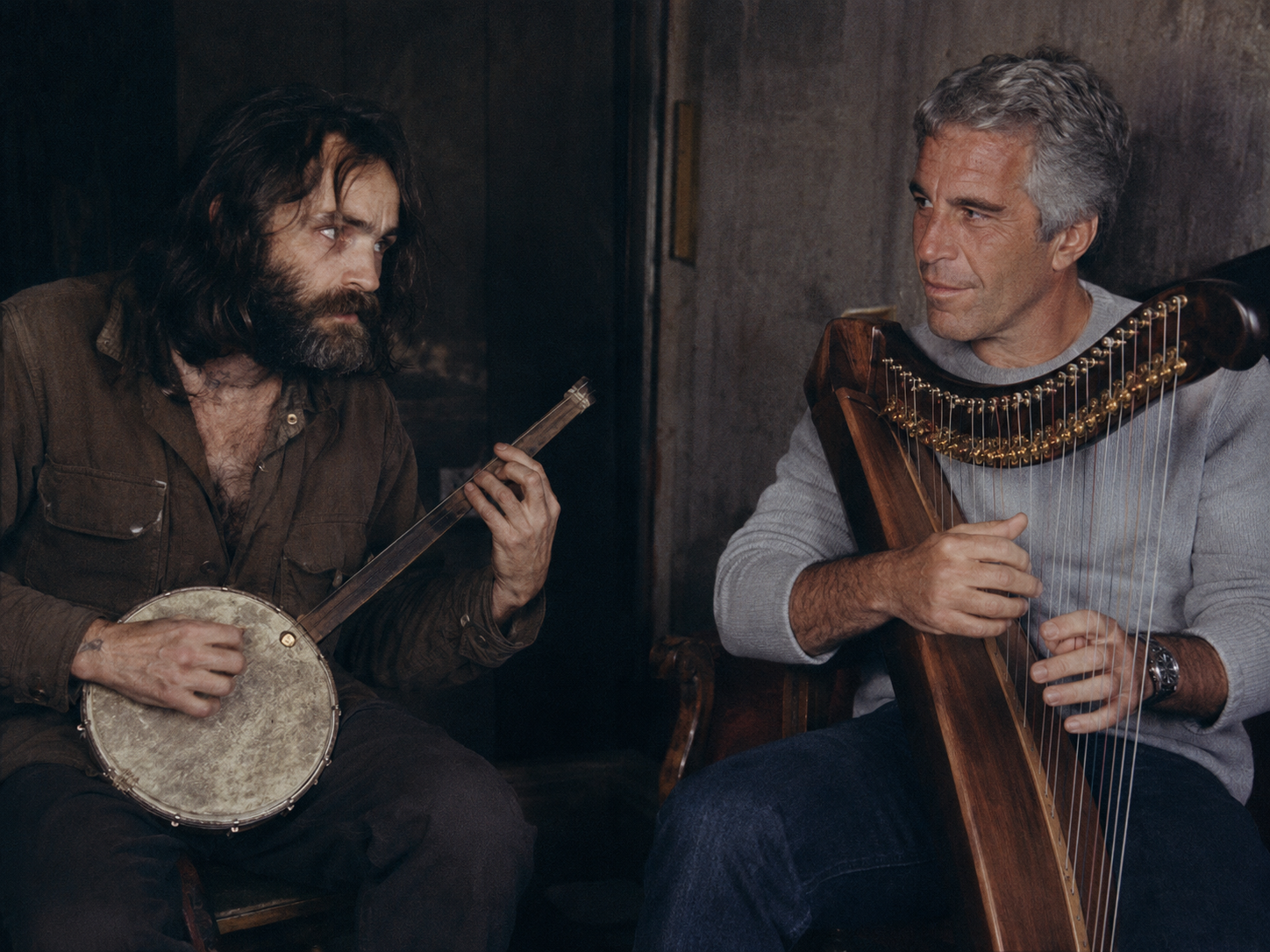
Manson and Epstein were not opposites. They were not even merely comparable predators from different social worlds. They were instances of the same object: the counterfeit shaman, the adaptive con man who inserts himself between a person and the hidden order that person longs to enter. One appeared in the dirt and heat of the counterculture with a one-string banjo. The other appeared in elite society with a harp. The instruments were different. The player was the same.
That distinction matters because the usual comparison keeps them too far apart. Manson is normally placed in the world of cults, communes, prison mysticism, drugs, sex, music, apocalypse, and murder. Epstein is placed in the world of money, science, philanthropy, private jets, lawyers, islands, and elite impunity. The contrast flatters the second world by making it seem structurally different from the first. It suggests that one was a deranged outsider while the other was a sophisticated insider. But that is only costume. The underlying operation was identical. Each man located hunger, renamed reality, offered initiation, and made himself the gate.
The one-string banjo and the harp are not symbols of different species of predator. They are symbols of the same species adapting to different rooms. Manson needed one string because his world rewarded compression. He could reduce everything to family, love, freedom, betrayal, death, and revelation. Epstein needed many strings because his world rewarded modulation. He could play money, glamour, pity, ambition, opportunity, science, secrecy, friendship, employment, and access. But the music did the same work. It produced permission. It made the listener feel selected, exempt, initiated, and dependent.
Manson’s con was not that he was a prophet. That was just the costume the con wore. The real offer was passage out of ordinary life. He sold escape from parents, shame, work, law, bourgeois morality, and the humiliations of being nobody. He did not need education because he had something more useful to the con man: mark-specific fluency. He could hear what the person in front of him lacked and then present himself as the answer. To one person he offered family. To another he offered rebellion. To another he offered sexual freedom. To another he offered revenge. To another he offered cosmic meaning. Once the person entered the circle, the separate pitches narrowed into one chant: Charlie knows the real truth.
Epstein’s con was the same object in formal clothes. His offer was not escape from the world but entrance into the world above it. He sold access to money, rooms, travel, adults, powerful men, rare knowledge, sophistication, protection, and exemption from ordinary limits. He also did not need real credentials in the deepest sense, because his authority was performative. He learned the speech of finance, mathematics, philanthropy, science, academia, and elite sociability well enough to pass through their gates and make other people feel that he was himself a gate. Where Manson said, “I can get you out,” Epstein said, “I can get you in.” Those are not opposite promises. They are the same promise pointed in opposite directions: follow me and the rules no longer apply.
This is why language is central. Neither man simply lied. A lie leaves the ordinary world intact and inserts a false statement into it. Their deeper skill was more radical. They changed the names of things. Manson could rename submission as freedom, degradation as love, violence as awakening, and obedience as truth. Epstein could rename exploitation as massage, trafficking as travel, payment as help, grooming as opportunity, silence as discretion, and complicity as sophistication. Once the name changes, the moral size of the act changes. Resistance begins to feel excessive because the language has made the crime sound smaller than it is.
The shamanic analogy is useful only if it is kept dark and precise. In an older society, the person who claimed access to invisible rules might be healer, mediator, dream-reader, curse-lifter, spirit-speaker, or interpreter of taboo. The healthy form of that role serves the group and remains answerable to it. The corrupted form privatizes the mystery. The counterfeit shaman makes himself the necessary passage point. He does not interpret the hidden world for the community; he uses the hidden world to make the community orbit him.
That is the object Manson and Epstein both instantiate. Manson’s hidden world was cosmic, sexual, apocalyptic, and anti-social. Epstein’s hidden world was institutional, sexual, financial, and elite. But in both cases the hidden world was a stage set built around the same central demand: you need me to cross the boundary. Both men sold initiation. Both sold exemption. Both made ordinary morality appear to be a rule for outsiders. Both made the victim or follower feel that the predator possessed the real map.
Nietzsche enters here as a warning, not as an excuse. Both men resemble counterfeit Nietzscheans: men who treated inherited morality as something to be overcome, but who replaced it with nothing higher than appetite. They did not create values. They dissolved values and called the vacancy freedom. Manson made transgression feel like revelation. Epstein made transgression feel like sophistication. Each offered a crude version of being beyond good and evil, when what he really meant was being beyond accountability.
The strongest comparison, then, is not that Manson was crude and Epstein was refined. That still makes them too different. The stronger claim is that refinement and crudeness were merely local dialects. Manson spoke the dialect of the desert cult. Epstein spoke the dialect of the private island and the donor dinner. Each dialect had its own music, but both performed the same spell. The spell said that the world has hidden rules, that ordinary people do not understand them, that shame is for the uninitiated, and that the man speaking is the doorway through which reality must be entered.
The photograph of the two men playing together works because it strips away the false opposition. The banjo and the harp do not show two souls. They show one mechanism expressed through two instruments. The banjo is not less dangerous because it is primitive. The harp is not less obscene because it is elegant. Both are tools for tuning the listener. Both are ways of making dependency sound like music.
Manson and Epstein were repetitions of the same object. One arrived as the filthy prophet of escape, the other as the polished broker of access. One played one string until the world collapsed into his voice. The other played many strings until every listener heard a different invitation. But the purpose was identical. They sold passage beyond ordinary rules, and the price of passage was submission to them.