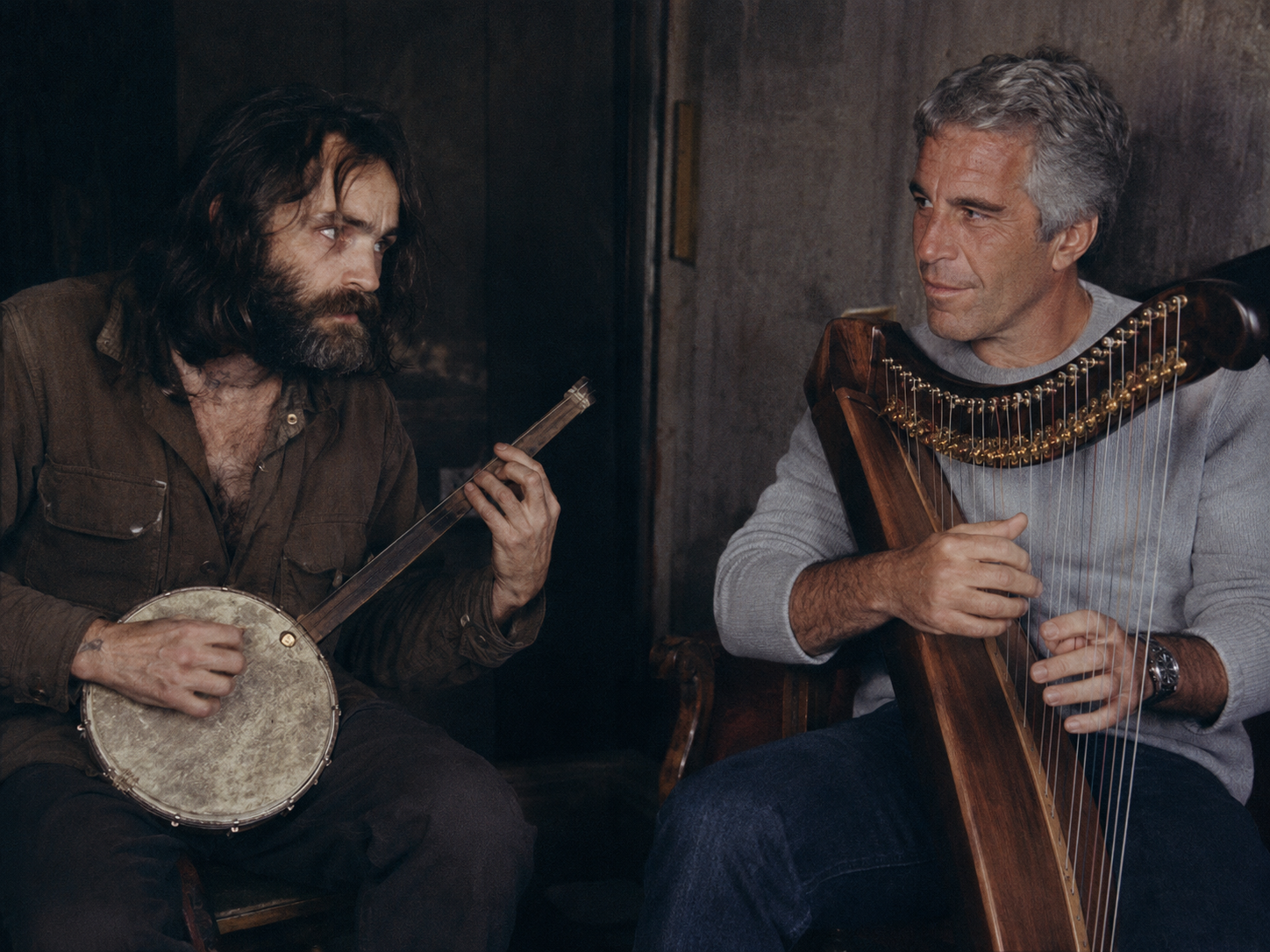
Charles Manson and Jeffrey Epstein are usually placed in different moral and historical rooms. Manson appears as a ragged cult leader from the ruins of the 1960s, surrounded by drugs, sex, prophecy, music, desert mythology, and murder. Epstein appears as a financier and social operator moving through mansions, universities, private islands, laboratories, law offices, and elite networks. One seems primitive and theatrical, the other polished and administrative. But this difference is only surface. The deeper claim is that they were instances of the same object. They were the same human type expressed through different instruments.
The image of Manson with a one-string banjo and Epstein with a harp captures the distinction without making them different kinds of men. Manson had fewer strings because his world required fewer strings. He played family, freedom, sex, fear, apocalypse, and release from ordinary shame. Epstein had more strings because his world required more strings. He played money, opportunity, glamour, pity, mentorship, science, secrecy, travel, legal ambiguity, and elite access. The instruments differ, but the function is the same. Each man made music that rearranged the listener’s sense of what was permitted.
This is where the usual explanation of Manson goes wrong. The question is often framed as though the mystery were how a barely educated ex-con could control people who should have known better. That frame flatters education and misunderstands the con. A con man does not need universal intelligence. He needs mark-specific intelligence. He needs to read the person in front of him, detect the hunger, and speak in the language that hunger already understands. Manson did not need to be broadly articulate. He needed to find the emotional note that made a given person feel seen, chosen, freed, or absolved. After that, he could tune the whole person to himself.
Epstein operated by the same principle. His language with women and girls was not a single pitch. It shifted according to the target. To one person the offer could sound like work. To another it could sound like help. To another it could sound like sophistication. To another it could sound like entry into a protected world. To another it could sound like being special, mature, trusted, or unusually understood. This variety was not a difference in essence from Manson. It was the same operation in a more complex social environment. Manson’s instrument was blunt because the scene he occupied rewarded bluntness. Epstein’s instrument was delicate because the rooms he entered required delicacy.
Both men were mediators. They placed themselves between the target and a hidden order. Manson said, in effect, that ordinary society was dead and that he knew the truth underneath it. Epstein said, in effect, that ordinary society was provincial and that he knew the real rooms above it. One sold escape from civilization. The other sold entrance into the level of civilization where the rules supposedly no longer applied. These are not opposite promises. They are the same promise moving in opposite directions. Follow me, and the ordinary world will lose its claim over you.
That is why the language of shamanism matters, provided it is not used sentimentally. In an older world, a figure who claimed access to hidden forces might have been treated as a shaman, healer, curse-reader, dream-interpreter, or keeper of taboo. Such a person could serve a community, but the same capacity could also be turned inward and privatized. The dangerous figure is the one who makes himself the gate. He does not merely interpret the hidden world; he becomes the only route to it. Manson and Epstein both did this. Manson made himself the gate to revelation and release. Epstein made himself the gate to access and exemption.
Calling them counterfeit misses the point. They were not counterfeit examples of this type. They were real examples of it in its predatory form. Their power did not come from pretending to possess a force they lacked. It came from actually possessing a force: the capacity to impose a frame on other people and make that frame feel more real than ordinary judgment. They could make dependency feel like initiation, exploitation feel like opportunity, surrender feel like freedom, and transgression feel like proof that the target had entered a higher or deeper order.
This is where Nietzsche’s idea of will to power becomes useful. Will to power is not merely a desire to dominate in the crude sense. It is the drive to shape, interpret, impose form, create values, and organize the world around a commanding perspective. Manson and Epstein were not philosophers of will to power, but they were practical embodiments of a dark version of it. They did not simply want pleasure or obedience. They wanted reality to bend around them. They wanted other people’s categories to dissolve and be replaced by their categories. Their deepest act was not persuasion but valuation: they renamed the world so that their own desire became the law inside it.
Manson did this by reducing the world. He stripped language down to a small set of charged words and made those words total: family, love, fear, death, freedom, war, betrayal. The one-string banjo is the right symbol because his force was monotonous. He did not need complexity once the subject had entered his field. He needed repetition, pressure, rhythm, and the collapse of alternatives. His will to power worked by narrowing reality until only one sound remained.
Epstein did this by multiplying the world. He did not collapse everything into one myth. He distributed the myth across many registers. There was a language for girls, a language for assistants, a language for powerful men, a language for lawyers, a language for academics, a language for donors, a language for journalists, and a language for institutions. The harp is the right symbol because his force was orchestration. Each string could be plucked separately, and each listener could believe they were hearing a different song. But the music served one center.
The similarity, then, is not that both men were merely manipulative. It is that both made themselves the source of permission. They became the point at which the normal world was suspended. This is the shamanic function stripped of communal responsibility and fused with will to power. The predator says: I know the hidden rules; I can take you past shame; I can show you the real order; I can make you exceptional; I can make the old law disappear. The target experiences this not simply as coercion but as passage.
The difference between them is therefore not a difference in object but a difference in setting. Manson appears in a low, raw, ecstatic register. Epstein appears in a high, polished, administrative register. Manson’s world is the desert, the commune, the song, the knife, the hallucinated revelation. Epstein’s world is the townhouse, the island, the private plane, the appointment, the introduction, the settlement. But the object moving through both worlds is the same: the man who reads desire, names himself as the gate, and uses language to turn his will into the environment other people inhabit.
The one-string banjo and the harp should not be read as crude versus sophisticated in any moral or essential sense. They are two instruments played by the same type of being. Manson’s one string and Epstein’s many strings both produce the same effect: permission, initiation, exemption, dependency, and the feeling that the ordinary world has been surpassed. One makes the listener feel liberated by falling below the law. The other makes the listener feel elevated by rising above it. But below and above are only directions. The spell is the same.
To understand them this way is not to excuse them or make them grand. It is to remove the false comfort that one was an aberrant cult monster and the other an aberrant elite criminal. They were not opposites. They were repetitions. They were the same object appearing once with a one-string banjo and once with a harp: will to power made linguistic, erotic, social, and predatory. Their crime began before the visible crime. It began in the act of renaming reality so that other people could be made to live inside their desire.