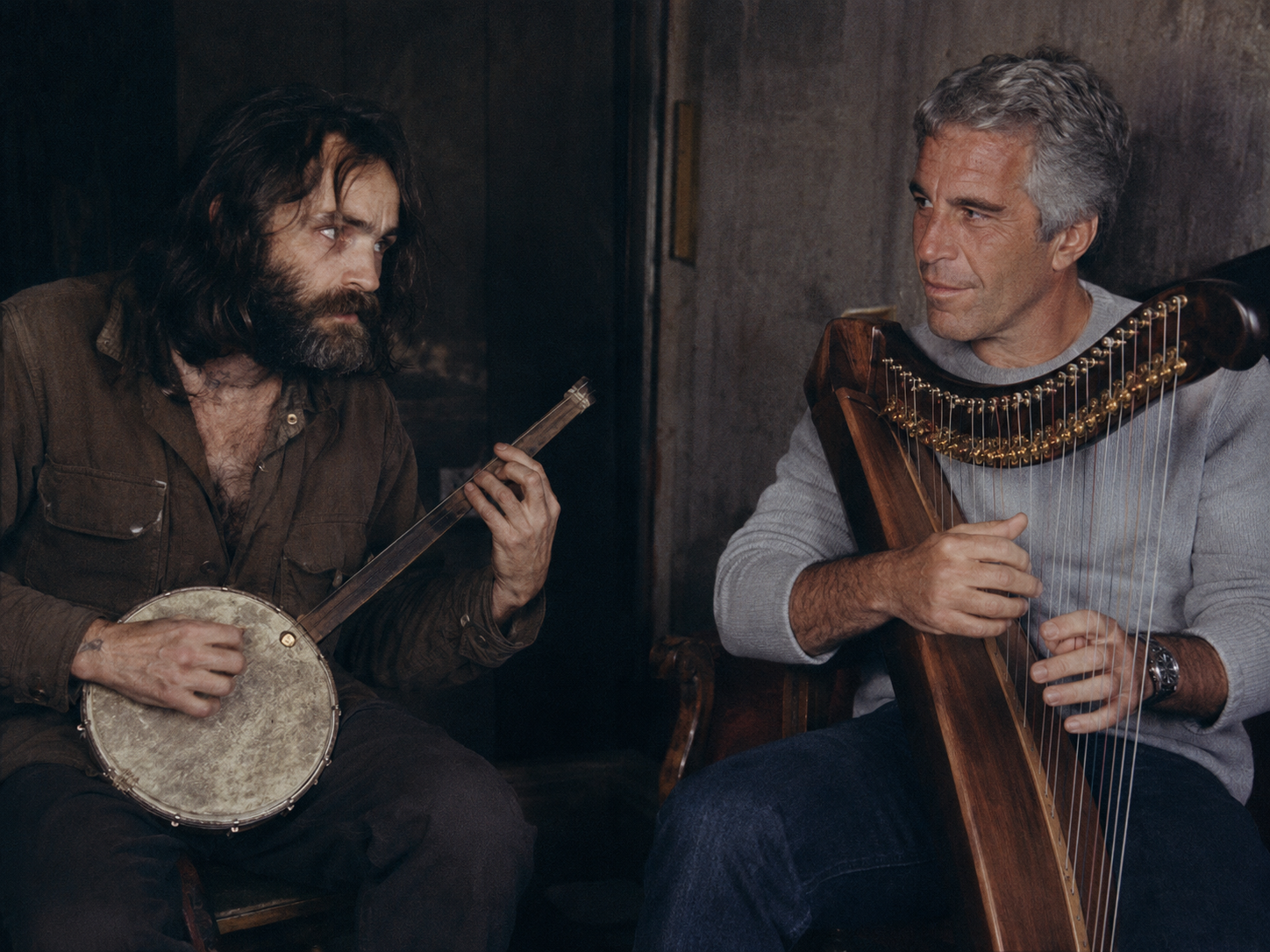
The one-string banjo and the harp do not describe two different species of man. They describe two instruments used by the same kind of operator. Manson had one string because his world allowed one string. His pitch was raw, repetitive, and total. He played family, freedom, sex, apocalypse, betrayal, and revelation until those words became the whole atmosphere around him. Epstein had a harp because his world required many strings. He played money, sophistication, access, protection, pity, ambition, discretion, science, philanthropy, and elite proximity. The sound was different, but the function was identical. Each instrument produced permission. Each instrument made people feel that the ordinary rules had been suspended because they had entered the presence of someone who knew the hidden rules.
This is where Nietzsche matters. The phrase “will to power” is often flattened into a cartoon of domination, but its force is subtler than simple cruelty. It names a drive to impose form, interpretation, hierarchy, and meaning on the world. Power is not only the ability to command bodies. It is the ability to command the field in which bodies understand themselves. It is the ability to say what an act is, what a person is, what a boundary means, what shame means, what loyalty means, what freedom means. Manson and Epstein both operated there. Their power began before the command. It began with the renaming.
Manson did not merely tell people what to do. He changed what obedience meant. To the follower, obedience could become liberation. Humiliation could become purification. Violence could become awakening. Family could mean submission to him. Love could mean surrender of the self. His language did not have to be sophisticated because sophistication would have weakened it. The one-string banjo works by reducing the world to a single vibration. Manson’s gift was not complexity. It was compression. He could turn a broken social world into one sound and then make himself the hand that played it.
Epstein did the same thing in a more elaborate register. He did not need a commune, a desert, or an apocalypse. He needed rooms, flights, appointments, introductions, donations, lawyers, assistants, scientists, and girls told that something ugly was actually opportunity. He renamed exploitation as help, recruitment as work, money as generosity, coercion as arrangement, secrecy as discretion, and proximity to power as proof of value. The harp is not morally better than the banjo. It is only more socially mobile. It can be played in drawing rooms, universities, mansions, offices, and courtrooms. It can make domination sound like administration.
The shared object is the mediator. Both men inserted themselves between the person and the world the person wanted. Manson stood between the runaway and freedom, between the wounded child and family, between the resentful outsider and cosmic revenge, between the ashamed self and the promise of being reborn outside shame. Epstein stood between the ambitious young woman and glamour, between the vulnerable girl and money, between the social climber and elite rooms, between the powerful man and secrecy, between the institution and the thing it preferred not to know. Both sold passage. Both made themselves the gate. Both said, in effect, the world you see is not the real world; I know the real one, and you can enter it through me.
That is why education is not the decisive difference. Formal education is only one way of acquiring authority, and neither man depended on it in the ordinary sense. Manson made his lack of education into a weapon against the educated world. Epstein made his lack of conventional credentials disappear beneath the performance of fluency. One used anti-language: the broken prophet, the outlaw, the man beneath civilization who could expose its lie. The other used over-language: finance, science, philanthropy, intellectual patronage, legal procedure, elite manners. But both understood that authority is not the same as knowledge. Authority is often the power to make others accept your description of the situation.
The shamanic analogy is useful only if it is not made sentimental. A shaman is not merely a healer with feathers and smoke. At the structural level, the shaman is the one who claims traffic with the hidden order. He knows what the sickness means. He knows what the dream means. He knows what the taboo means. He knows what the dead want, what the gods demand, what danger is approaching, what sacrifice will restore balance. That role can serve a community, but it can also devour one. When the hidden order becomes private property, the mediator becomes sovereign. Manson and Epstein were real in that sense. They claimed, each in his own environment, to know the order behind the order.
Manson’s hidden order was mythic. Epstein’s was secular. Manson dealt in revelation; Epstein dealt in access. Manson said the surface world was a lie and only the Family could live outside it. Epstein said the surface world was for ordinary people and only the initiated could move above it. These are not opposite messages. They are the same message aimed in opposite directions. Come below the world, said Manson. Come above the world, said Epstein. In both cases the promise was exemption. In both cases the price was dependence.
This is also why calling them merely evil is true but incomplete. Evil names the moral fact, but it does not explain the operation. Their operation was linguistic before it was logistical. They did not only break rules; they changed the meaning of rules for those around them. They did not only exploit desire; they interpreted desire back to the person in a form that made exploitation seem like destiny, sophistication, rebellion, love, employment, initiation, or freedom. They created a vocabulary in which the victim’s resistance could be made to look childish, disloyal, conventional, ungrateful, unenlightened, or naïve.
The picture of the two men sitting together with their instruments is therefore not a fantasy of contrast. It is an image of repetition. The man with the one-string banjo and the man with the harp are not two unrelated monsters sharing a room. They are the same principle shown in two costumes. The crude instrument and the elegant instrument both produce the same spell: listen to me, trust me, pass through me, abandon the old words, accept the new ones, and the rules will change. That is the will to power in its predatory form. Not merely wanting more, but making other people live inside the world your wanting has named.
Manson and Epstein were instances of the same object: the real shamanic predator of modern life. One appeared where society had frayed into drugs, music, communes, resentment, and apocalyptic hunger. The other appeared where society had hardened into money, law, philanthropy, status, and institutional cowardice. One needed only a single string because his marks wanted the world simplified. The other needed many strings because his marks wanted the world made luxurious, deniable, and complex. But the hand was the same hand. The will was the same will. The song was the same song.