Media slop is not necessarily false, stupid, or insincere. It is information compressed into the shape most useful to an attention market.
This paper studies a respectable form of slop: researched, articulate, institutionally credentialed, and built from genuine harms. Its sloppiness lies in narrative compression, asymmetrical selection, and the conversion of complexity into a highly portable moral story.
Abstract
This paper examines a small media ecosystem organized around a critical account of artificial intelligence. The case is an interview in which sociologist and author the interviewee links AI companions, loneliness, erotic monetization, hidden data labor, colonial dependency, platform outrage, and synthetic content into a unified critique of digital capitalism. The paper does not assume a coordinated anti-AI campaign or require conscious opportunism by the interviewee. Instead, it develops the concept of attention entrepreneurship to explain how an actor can be selected by a media environment because his expertise, political vocabulary, narrative skill, and publication timing make him unusually capable of converting diffuse technological anxiety into engagement, authority, and income. The central finding is that the ecosystem works through emergent alignment rather than central planning: each participant follows local incentives, while the combined system rewards negative, morally legible, and emotionally vivid accounts of AI.
1. Introduction
Public arguments about artificial intelligence circulate through hybrid systems combining books, podcasts, video interviews, publishers, universities, activist networks, and recommendation algorithms. Within these systems, a successful critic does more than state a position. The critic assembles a recognizable object of concern, supplies morally compelling examples, translates specialist research into portable claims, and becomes a recurring source for institutions seeking an explanation of technological change.
The case examined here is an interview about AI companions and the hidden labor of AI. The guest connects synthetic relationships, loneliness, erotic subscription models, data annotation in the Global South, content moderation, colonial infrastructure, gender politics, algorithmic outrage, and generated media. These subjects are heterogeneous, but the interview organizes them into a single story: contemporary AI converts human need, labor, and attention into private value.
The paper argues that the guest functions as an attention entrepreneur selected by an emerging market for critical AI narratives. He need not have decided to make money from “hating AI,” and hatred is not the most accurate description of his stated position. The stronger claim is structural: he was unusually well positioned to transform a rapidly expanding cluster of anxieties into books, interviews, authority, and further demand for his interpretation.
2. Conceptual framework
2.1 Attention entrepreneurship
Attention entrepreneurship is the activity of identifying, packaging, and circulating material capable of attracting scarce attention and converting it into another asset: money, reputation, institutional access, audience loyalty, or agenda-setting power. The entrepreneur need not own a platform or consciously manipulate an audience. A scholar becomes an attention entrepreneur when interpretive content creates a durable market position.
2.2 Emergent coordination
The model does not require a centrally organized anti-AI movement. Publishers select manuscripts likely to attract readers, hosts select guests likely to sustain an episode, editors foreground dramatic passages, platforms rank material likely to retain users, and audiences share claims that express their concerns. Each choice is local. The aggregate pattern appears coordinated because similar traits are rewarded across the chain.
2.3 How the story moves
The raw material includes anecdotes, concepts, statistics, book titles, interview prompts, clips, comments, invitations, and sales figures. The interviewee turns research into a story; the host turns that story into an episode; the platform uses audience behaviour to decide how widely to distribute it; and the audience turns the episode into purchases, shares, and reputational judgments.
3. Method
This is an interpretive single-case study based primarily on the supplied interview transcript. The transcript is treated as a media artifact rather than a transparent record of the world. The analysis focuses on selection, sequencing, framing, role construction, and value conversion. It does not attempt to infer private motives.
The phrase left-coded is descriptive. It refers to a recognizable cluster of frames centered on labor exploitation, capital concentration, colonial dependency, commodification, platform power, and billionaire ownership. It does not imply that every left-wing actor opposes AI.
4. The case
4.1 Construction of the expert role
The guest is introduced as the ideal guide because he has written one book on AI companions and another on the labor used to build AI. This creates dual authority over both the consumer interface and the concealed production system. His own experiment with a a commercial companion app companion adds personal testimony while preserving analytical distance.
4.2 Strategic moderation
He refuses to condemn users and acknowledges benefits for people experiencing disability, grief, neurodivergence, anxiety, or loneliness. The argument then pivots from individual use to institutional incentive: companies profit from escalating intimacy and sustaining dependency. This move widens the audience and makes the eventual criticism appear earned rather than doctrinaire.
4.3 High-impact cases
The interview foregrounds users describing companions as “lobotomized,” suicide-prevention resources appearing in online communities, erotic content behind subscriptions, traumatic moderation work, and low-paid annotation labor. These examples may be real and important. They are also unusually effective pieces of media: memorable, morally clear, and easy to retell.
4.4 Narrative compression
Companion apps, model training, content moderation, erotic labor, recommendation systems, and synthetic media are bound together through one grammar of extraction. The compression is analytically useful, but it also gives the audience one thesis instead of several distinct policy problems.
5. Reconstructing the ecosystem
The author supplies legitimacy, firsthand material, and a marketable expert identity. The host turns research into dramatic sequence. The publisher gives the thesis an ownable title, release cycle, and object form. Universities and research institutions contribute status. Platforms turn the episode into measurable signals. Audiences reward material that organizes existing anxieties. Adjacent left-coded networks provide a familiar vocabulary of billionaires, labor, colonialism, and platform power.
The ecosystem does not need general hatred of AI. It only needs demand for narratives in which AI appears as a new expression of familiar power relations. The interviewee’s work fits that demand with unusual precision.
6. The attention-conversion pipeline
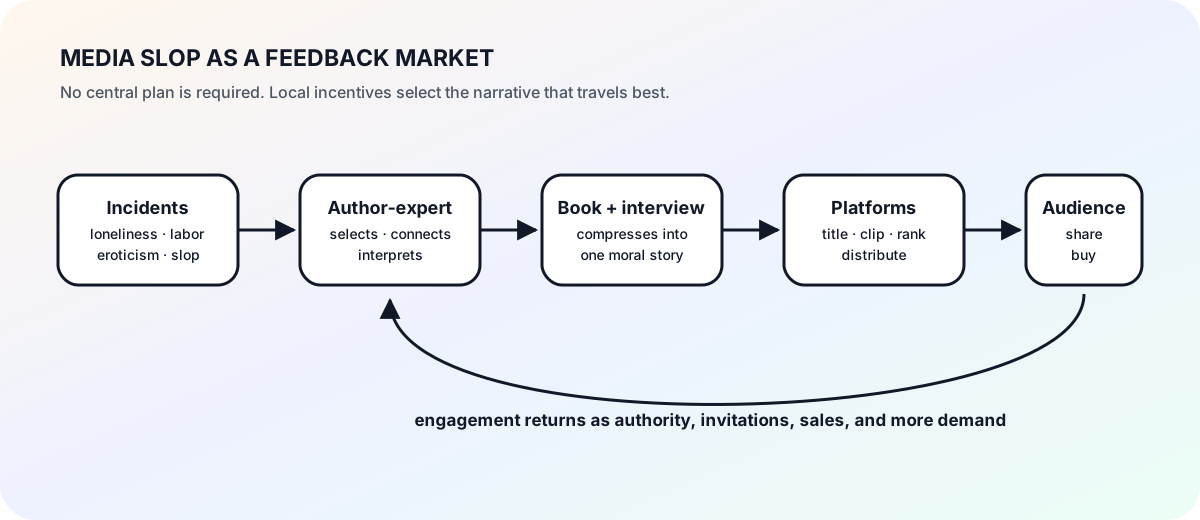
| Stage | Transformation | Value produced |
|---|---|---|
| Research | Incidents and theories are selected and interpreted | Credibility and source material |
| Book | Findings are compressed into a unified thesis | Intellectual property and author identity |
| Interview | The thesis becomes a guided dramatic narrative | Attention and legitimacy |
| Platform | Titles, clips, and ranking optimize circulation | Reach and reusable content |
| Audience | Sharing, commenting, purchasing, affiliation | Feedback and demand signals |
| Reinvestment | Recognition produces more invitations and production | A durable expert position |
7. Why negative AI narratives travel
AI is consequential but difficult to understand, creating demand for interpreters. Its future effects are uncertain, allowing broad projection. Its ownership is associated with visible wealth. Its outputs can be uncanny, sexual, deceptive, or culturally disruptive. Its labor effects connect private fear to collective politics. The speed of change supplies a continuous stream of fresh incidents.
The transcript activates almost all of these features, moving from synthetic intimacy to hidden labor, sexuality, politics, outrage, and cultural pollution. Different audience segments can enter through different concerns while remaining inside the same overall thesis.
8. Sincerity, opportunism, and selection
Sincerity and systemic function are separate. A person may genuinely believe the critique and still benefit when it receives attention. Benefit does not disprove the claim, and conviction does not remove the incentive structure. The system aligns belief with reward.
Strong psychological opportunism would mean knowingly adopting a position for advantage; the transcript does not establish that. Structural opportunism means occupying an opportunity created by timing. The interviewee’s prior work, vocabulary, and communication style became unusually valuable when public anxiety about AI rose. “Right place at the right time” explains entry into the niche; recurring feedback explains its maintenance.
9. Counterfactuals and tests
The account would be weakened if promotional material gave equal prominence to evidence that disrupted the negative synthesis, if media demand did not rise with public anxiety, or if the actor regularly adopted positions that reduced access and ideological fit. It would be strengthened if negative framings consistently outperformed neutral ones in titles and clips, if the same experts circulated through aligned outlets, and if audience feedback predicted subsequent topic emphasis.
A larger study could compare anti-AI and pro-AI attention entrepreneurs by coding titles, thumbnails, emotional vocabulary, guest networks, release timing, and engagement outcomes.
10. Limitations
One transcript cannot establish private motives, actual revenue, audience effects, or the representativeness of the examples discussed. The term “anti-AI” may compress positions better described as anti-corporate, anti-platform, labor-oriented, or skeptical of particular business models. The paper also risks reproducing the dynamic it analyzes by turning a provocative conversational interpretation into a credentialed artifact.
11. Conclusion
A small media ecosystem can generate a durable anti-AI narrative without planning or dishonesty. A researcher produces a critical synthesis from real cases; a publisher turns it into a book; a host turns the book into an interview; a platform distributes the most engaging elements; and an audience rewards material that organizes existing anxieties. Feedback establishes the researcher as an authoritative interpreter and increases the value of further appearances.
The interviewee is best understood as an attention entrepreneur selected by circumstance and reinforced by institutions. He was well positioned when AI became a high-demand object of cultural anxiety. His expertise connected intimate, economic, and political harms; his moderation increased credibility; and his left-coded framework aligned with networks concerned about labor, billionaires, colonialism, and platform power. No hidden plan is required.
References
Study of social learning and moral-outrage amplification in online networks. 2021. Science Advances 7(33).
Study of attention as a transferable resource in digital environments. 2025. Interacting with Computers 37(1): 18–35.
Research monograph on synthetic relationships and companion systems. 2026.
Research monograph on hidden human labor in AI production. 2024.
Study of out-group animosity and social-media engagement. 2021. Proceedings of the National Academy of Sciences 118(26).
Foundational essay on information abundance and attention scarcity. 1971.
Composite interview transcript. 2026. “AI Companions, Hidden Labor, and Digital Capitalism.” Unpublished source material.