Credential slop
Authority
Formatting, affiliation, citation density and methodological display create the response “this is rigorous.”
It is the act of selecting, shaping and circulating information for the reaction it produces rather than the understanding it creates.
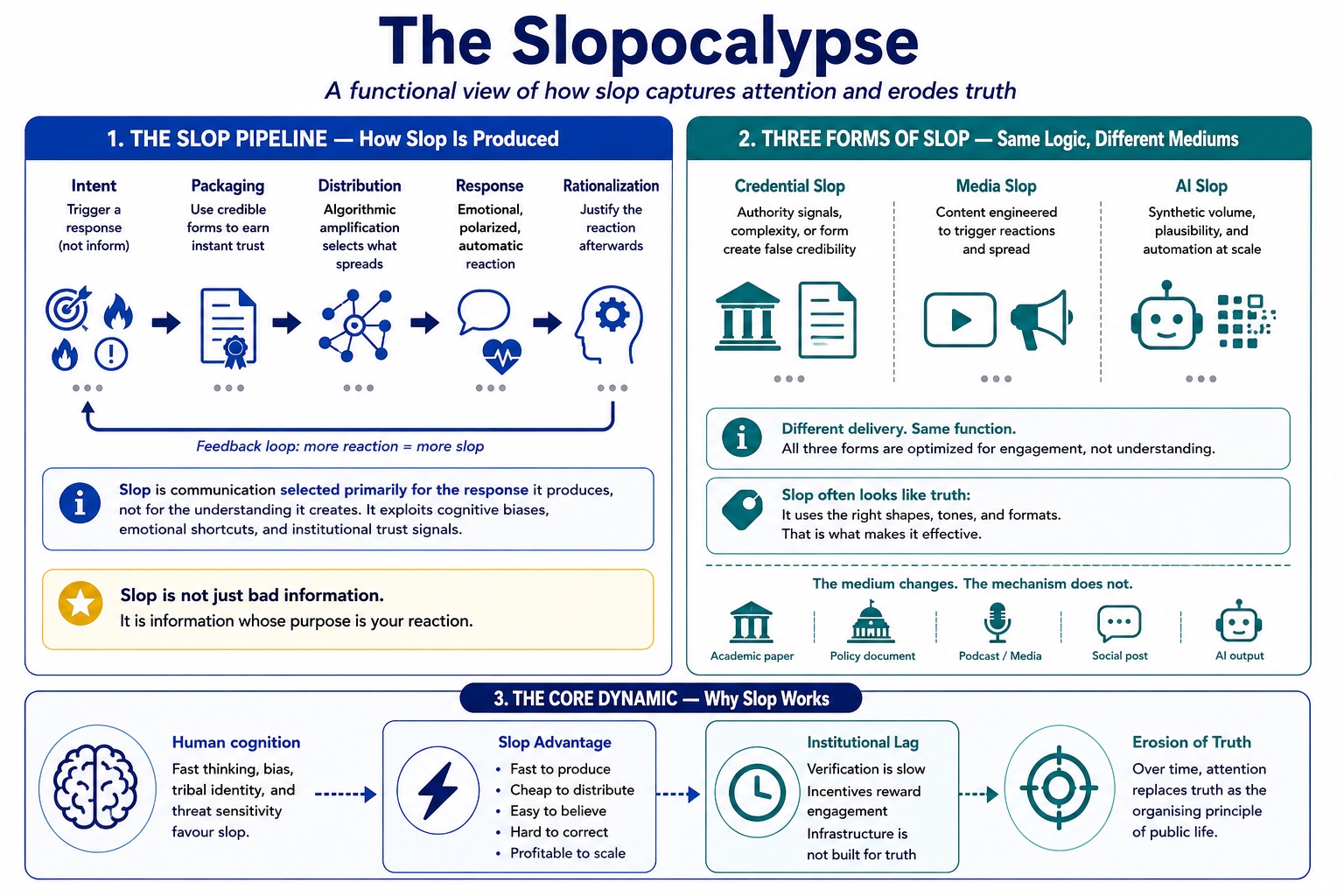
Different institutions optimise for different reactions, but the structural tendency is similar.
Formatting, affiliation, citation density and methodological display create the response “this is rigorous.”
Conflict, novelty, repetition and emotional charge create the response “this matters now.”
Fluency, abundance and responsiveness create the response “the task has been done.”
The framework becomes useful only when it can distinguish slop from ordinary simplification, interpretation and error.
A statement can be true while the system selects it for a reason unrelated to truth.
No producer needs to intend deception. The output can function as slop because of how it is rewarded and reused.
The same paragraph can be informative in one context and slop in another if it is detached from its limits and circulated as a conclusion.
Clicks, citations, adoption and approval are observable. Understanding is harder to measure, so systems substitute the former for the latter.
The Slopocalypse is not the arrival of universally bad content. It is the expansion of systems that cannot reliably tell why content succeeded.